
Future of the World

Status
Not open for further replies.

licks2nite

Well-known member
Nov 30, 2006
1,209
250
83
The Extinction Of Christians In The Middle East
Wed, 08/21/2019
Authored by Giulio Meotti, The Gatestone Institute

"I don't believe in these two words [human rights], there are no human rights. But in Western countries, there are animal rights. In Australia they take care of frogs.... Look upon us as frogs, we'll accept that — just protect us so we can stay in our land." — Metropolitan Nicodemus, the Syriac Orthodox archbishop of Mosul, National Catholic Register.

"Those people are the same ones who came here many years ago. And we accepted them. We are the original people in this land. We accepted them, we opened the doors for them, and they push us to be minorities in our land, then refugees in our land. And this will be with you if you don't wake up." — Metropolitan Nicodemus.

"Threats to pandas cause more emotion" than threats to the extinction of the Christians in the Middle East. — Amin Maalouf, French-Lebanese author, Le Temps.

Most Christian churches in and around Mosul, Iraq were desecrated or destroyed by ISIS. Pictured: The heavily damaged bell tower of Saint John's Church (Mar Yohanna) in the town of Qaraqosh, near Mosul, on April 16, 2017. (Photo by Carl Court/Getty Images)

Convert, pay or die. Five years ago, that was the "choice" the Islamic State (ISIS) gave to Christians in Mosul, then Iraq's third-largest city: either embrace Islam, submit to a religious tax or face the sword. ISIS then marked Christian houses with the Arabic letter ? (N), the first letter of the Arabic word "Nasrani" ("Nazarene," or "Christian") . Christians could often take no more than the clothes on their back and flee a city that had been home to Christians for 1,700 years.

Two years ago, ISIS was defeated in Mosul and its Caliphate crushed. The extremists, however, had succeeded in "cleansing" the Christians. Before the rise of ISIS, there were more than 15,000 Christians there. In July 2019, the Catholic charity, Aid to the Church in Need, disclosed that only about 40 Christians have come back. Not long ago, Mosul had "Christmas celebrations without Christians".

This cultural genocide, thanks to the indifference of Europeans and many Western Christians more worried about not appearing "Islamophobic" than defending their own brothers, sadly worked. Father Ragheed Ganni, for instance, a Catholic priest from Mosul, had just finished celebrating mass in his church when Islamists killed him. In one of his last letters, Ganni wrote: "We are on the verge of collapse". That was in 2007 -- almost ten years before ISIS eradicated the Christians of Mosul. "Has the world 'looked the other way' while Christians are killed?" the Washington Post asked. Definitely.

Traces of a lost Jewish past have also resurfaced in Mosul, where a Jewish community had also lived for thousands of years. Now, 2,000 years later, both Judaism and Christianity have effectively been annihilated there. That life is over. The newspaper La Vie collected the testimony of a Christian, Yousef (the name has been changed), who fled in the night of August 6, 2014, just before ISIS arrived. "It was a real exodus", Yousef said.

"The road was black with people, I did not see either the beginning or the end of this procession. There were children were crying, families dragging small suitcases. Old men were on the shoulders of their sons. People were thirsty, it was very hot. We have lost all that we have built for life and nobody fought for us".

Some communities, such as the tiny Christian pockets in Mosul, are almost certainly lost forever", wrote two American scholars in Foreign Policy.

"We are on the precipice of catastrophe, and unless we act soon, within weeks, the tiny remnants of Christian communities in Iraq may be mostly eradicated by the genocide being committed against Christians in Iraq and Syria".

In Mosul alone, 45 churches were vandalized or destroyed. Not a single one was spared. Today there is only one church open in the city. ISIS apparently also wanted to destroy Christian history there. They targeted the monastery of Saints Behnam and Sarah, founded in the fourth century. The monastery had survived the seventh century Islamic conquest and subsequent invasions, but in 2017, crosses were destroyed, cells were looted, and statues of the Virgin Mary were beheaded. The Iraqi priest, Najeeb Michaeel, who saved 850 manuscripts from the Islamic State, was ordained last January as the new Chaldean Catholic archbishop of Mosul.

ISIS, together with Al Nusra, an offshoot of al-Qaeda in Syria, followed the same pattern, when its militants attacked the Christian town of Maaloula. "They scarred the faces of the saints, of the Christ, they shattered the statues", Father Toufic Eid recently told the Vatican agency, Sir.

"The altars, the iconostases and the baptismal font were torn to pieces. But the thing that struck me most was the burning of baptism registers. It is as if they wanted to erase our faith".

In the cemetery of the church of St. George in Karamlesh, a village east of Mosul, Isis dug up a body and beheaded it, apparently only because it was a Christian.

The fate of Mosul's Christians is similar to those elsewhere in Iraq. "The International Union for the Conservation of Nature has several categories to define the danger of extinction that various species face today", writes Benedict Kiely, the founder of Nasarean.org, which helps the persecuted Christians of the Middle East.

"Using a percentage of population decline, the categories range from 'vulnerable species' (a 30-50 per cent decline), to 'critically endangered' (80-90 per cent) and finally to extinction. The Christian population of Iraq has shrunk by 83 per cent, putting it in the category of 'critically endangered'".

Shamefully, the West has been and still seems to be completely indifferent to the fate of Middle Eastern Christians. As the Syriac Orthodox archbishop of Mosul, Metropolitan Nicodemus, put it:

"I don't believe in these two words [human rights], there are no human rights. But in Western countries, there are animal rights. In Australia they take care of frogs.... Look upon us as frogs, we'll accept that — just protect us so we can stay in our land.

"Those people are the same ones who came here many years ago. And we accepted them. We are the original people in this land. We accepted them, we opened the doors for them, and they push us to be minorities in our land, then refugees in our land. And this will be with you if you don't wake up."

"Christianity in Iraq, one of the oldest Churches, if not the oldest Church in the world, is perilously close to extinction", Bashar Warda, Archbishop of Irbil, the capital of Iraqi Kurdistan, remarked in London in May.

"Those of us who remain must be ready to face martyrdom".

Warda went on to accuse Britain's leaders of "political correctness" over the issue for fear of being accused of "Islamophobia." "Will you continue to condone this never-ending, organised persecution against us?" Warda asked. "When the next wave of violence begins to hit us, will anyone on your campuses hold demonstrations and carry signs that say 'We are all Christians?'"

These Christians seem to have gained space on our television screens and newspapers only at the cost of their blood, their disappearance, their suffering. Their tragedy illuminates our moral suicide. As the French-Lebanese writer Amin Maalouf noted: "That is the great paradox: one accuses the Occident of wanting to impose its values, but the real tragedy is its inability to transmit them.... Sometimes we get the impression that Westerners have once and for all appropriated Christianity... and that they say to themselves: We are the Christians, and the rest is only an archaeological remainder destined to disappear. Threats to pandas cause more emotion" than threats to the extinction of the Christians in the Middle East.

Source: https://www.gatestoneinstitute.org/14691/extinction-christians-middle-east
 

licks2nite

Well-known member
Nov 30, 2006
1,209
250
83
The Real Reasons Why The Media Is Suddenly Admitting To The Recession Threat
Wed, 08/21/2019 - 17:25
Authored by Brandon Smith via Alt-Market.com


One thing that is important to understand about the mainstream media is that they do tell the truth on occasion. However, the truths they admit to are almost always wrapped in lies or told to the public far too late to make the information useful. Dissecting mainstream media information and sifting out the truth from the propaganda is really the bulk of what the alternative media does (or should be doing). In the past couple of weeks I have received a rush of emails asking about the sudden flood of recession and economic crash talk in the media. Does this abrupt 180 degree turn by the MSM (and global banks) on the economy warrant concern? Yes, it does.

The first inclination of a portion of the liberty movement will be to assume that mainstream reports of imminent economic crisis are merely an attempt to tarnish the image of the Trump Administration, and that the talk of recession is "overblown". This is partially true; Trump is meant to act as scapegoat, but this is not the big picture. The fact is, the pattern the media is following today matches almost exactly with the pattern they followed leading up to the credit crash of 2008. Make no mistake, a financial crash is indeed happening RIGHT NOW, just as it did after media warnings in 2007/2008, and the reasons why the MSM is admitting to it today are calculated.

Before we get to that, we should examine how the media reacted during the lead up to the crash of 2008.

Multiple mainstream outlets ignored all the crash signals in 2005 and 2006 despite ample warnings from alternative economists. In fact, they mostly laughed at the prospect of the biggest bull market in the history of stocks and housing (at that time) actually collapsing. Then abruptly the media and the globalist institutions that dictate how the news is disseminated shifted position and started talking about “recession” and “crash potential”. From the New York Times to The Telegraph to Reuters and others, as well as the IMF, BIS and Federal Reserve officials – Everyone suddenly started agreeing with alternative economists without actually deferring to them or giving them any credit for making the correct financial calls.

In 2007/2008, the discussion revolved around derivatives, a subject just complicated enough to confuse the majority of people and cause them to be disinterested in the root trigger for the economic crisis, which was central bankers creating and deflating bubbles through policy engineering. Instead, the public just wanted to know how the crash was going to be fixed. Yes, some blame went to the banking system, but almost no one at the top was punished (only one banker in the US actually faced fraud charges). Ultimately, the crisis was pinned on a “perfect storm” of coincidences, and the central banks were applauded for their “swift action” in using stimulus and QE to save us all from a depression level event. The bankers were being referred to as “heroes”.

Of course, central bank culpability was later explored, and Alan Greenspan even admitted partial responsibility, saying the Fed knew there was a bubble, but was "not aware" of how dangerous it really was. This was a lie. According to Fed minutes from 2004, Greenspan sought to silence any dissent on the housing bubble issue, saying that it would stir up debate on a process that “only the Fed understood”. Meaning, there was indeed discussion on housing and credit warning signs, but Greenspan snuffed it out to prevent the public from hearing about it.

Today we have a very similar dynamic.

Use of the “R word” in the mainstream media and among central banks has been strictly contained for the past several years. In the October 2012 Fed minutes, Jerome Powell specifically warned of what would happen if the Federal Reserve tightened liquidity and raised interest rates into economic weakness. He warned that this would have negative effects on the stimulus addicted investment environment that the central bank had fostered. This discussion was held back from the public until only a year-and-a-half ago. As soon as Powell became chairman, he implemented those exact actions.

Only in the past year has talk of recession begun to break out, and only in the past couple of weeks have outlets become aggressive in pushing the notion that a financial crash is just around the corner. The reality is that if one removes the illusory support of central bank stimulus, our economy never left the "Great Recession" of 2008. Signals of renewed sharp declines in economic fundamentals have been visible since before the 2016 elections. Alarms have been blaring on housing, auto markets, manufacturing, freight and shipping, historic debt levels, the yield curve, etc. since at least winter of last year, just as the Fed raised rates to their neutral rate of inflation and increased asset cuts from the balance sheet to between $30 billion to $50 billion or more per month.

The media should have been reporting on economic crisis dangers for the past 2-3 years. But, they didn't give these problems much credence until recently. So, what changed?

I can only theorize on why the media and the banking elites choose the timing they do to admit to the public what is about to happen. First, it is clear from their efforts to stifle free discussion that they do not want to let the populace know too far ahead of time that a crash is coming. According to the evidence, which I have outlined in-depth in previous articles, central banks and international banks sometimes engineer crash events in order to consolidate wealth and centralize their political power even further. Is it a conspiracy? Yes, it is, and it's a provable one.

When they do finally release the facts, or allow their puppet media outlets to report on the facts, it seems that they allow for around 6-8 months of warning time before economic shock events occur. In the case of the current crash in fundamentals (and eventually stocks), the time may be shorter. Why? Because this time the banks and the media have a scapegoat in the form of Donald Trump, and by extension, they have a scapegoat in the form of conservatives, populists, and sovereignty activists.

The vast majority of articles flowing through mainstream news feeds on economic recession refer directly to Trump, his supporters and the trade war as the primary villains behind the downturn. The warnings from the Fed, the BIS and the IMF insinuate the same accusation.

Anyone who has read my work for the past few years knows I have been warning about Trump as a false prophet for the liberty movement and conservatives in general. And everyone knows my primary concern has been that the globalists will crash the Everything Bubble on Trump's watch, and then blame all conservatives for the consequences.

To be clear, Trump is not the cause of the Everything Bubble, nor is he the cause of its current implosion. No president has the power to trigger a collapse of this magnitude, only central banks have that power. When Trump argues that the Fed is causing a downturn, he is telling the truth, but when he claims that recession fears are exaggerated, or "inappropriate", he is lying. What he is not telling the public is that his job is to HELP the Fed in this process of controlled economic demolition.

Admissions of crisis in the media are coinciding directly with Trump's policy actions. In other words, Trump is providing perfect cover for the central banks to crash the economy without receiving any of the blame. Trump's insistence on taking full credit for the bubble in stock markets as well as fraudulent GDP and employment numbers, after specifically warning about all of these things during his election campaign, has now tied the economy like a noose around the necks of conservatives. The tone of warning in the media indicates to me that the banking elites are about to tighten that noose.

Another factor on our timeline beyond Trump's helpful geopolitical distractions is the possibility of a 'No-Deal' Brexit in October. I continue to believe this outcome (or something very similar) has been pushed into inevitability by former Prime Minister Theresa May and EU globalists, and that it will be used as yet another scapegoat for the now accelerating crash in the EU. With Germany on the verge of admitting recession, Deutsche Bank on the edge of insolvency, Italy nearing political and financial crisis, etc., it is only a matter of months before Europe sees its own "Lehman moment". The Brexit is, in my view, a marker for a timeline on when the crash will hit its stride.

To summarize, the mainstream media and global banking institutions have two goals in informing the public about recession right now :

They are seeking to cover their own asses when the next shoe drops so they can say they "tried to warn us", and...

...they are conditioning a majority of the public to automatically blame conservatives and sovereignty proponents when the consequences hit them without mercy.

As the truth of a recession smacks the public in the face, the media will likely pull back slightly, just as they did in 2008, and suggest that the downturn is "temporary". They will claim it's "not a repeat of the credit crisis", or that it will "subside after Trump is out of office". These will all be lies designed to keep the public complacent even as the house of cards collapses around them. The fact is, the hard data shows that economic conditions in the US and in most of the world are far more unstable than they were in 2008. We are not looking at the crash of a credit bubble, we are looking at the crash of the 'Everything Bubble'.

The pace of the narrative is quickening, and I would suggest that a collapse of the bubble will move rather quickly, perhaps in the next four to six months. If it does, then it is likely that Trump is not slated for a second term as president in 2020. Trump's highly divisive support for “Red Flag” gun laws, a move that will lose him considerable support among pro-gun conservatives, also indicates to me that it is likely he is not meant to be president in 2020. This is another sign that a massive downturn is closing in.

As events are unfolding right now, it appears that Trump has served his purpose for the globalists and is slated to be replaced next year; probably by an extreme far-left Democrat. There are only a couple of scenarios I can imagine in which Trump remains in office, one of them being a major war which might require him to retain the presidency so the globalists can finish out a regime change agenda in nations like Iran or Venezuela. This could, however, be pursued under a Democrat president almost as easily as long as Trump and his elitist cabinet lay the groundwork beforehand. As in 2007/2008, it is unlikely that the mainstream would admit to a downturn that is not coming soon. Using the behavior of the media and of banking institutions as a guide, we can predict with some measure of certainty a crisis within the economy in the near term. Clearly, a major breakdown is slated to take place before the election of 2020, if not much sooner.

Source: http://alt-market.com/index.php/art...is-suddenly-admitting-to-the-recession-threat
 

80watts

Well-known member
May 20, 2004
3,343
1,266
113
Victoria
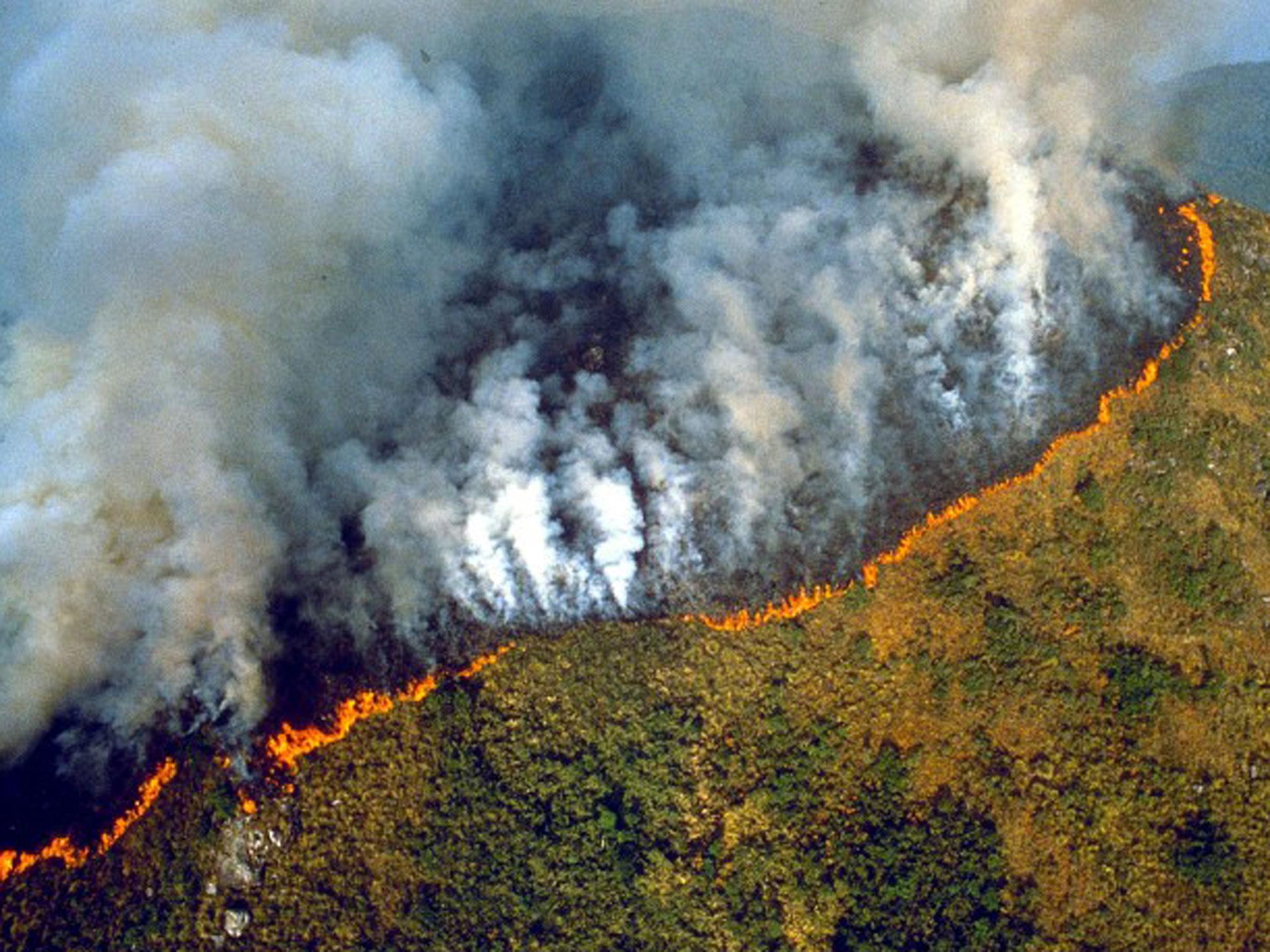
The land is burning due to farmers clearing land (the forest) to be able to farm or mine... The Amazon is not being protected by its government. It needs money so there is this bunch of forest that can make them all rich by burning it.... So thought full of them.....
 

superdude3

New member
Jan 29, 2019
8
0
0
he not you the people don't forget that and 2020 we might new prez Bernie sanders from Vermont hes for the people free heath care in america sound good to me.
 

superdude3

New member
Jan 29, 2019
8
0
0
ya trump is all about him self crazy it like me in way can't stop looking in the mirror at end of the day you the people are real heros tomm and the future this planet.
 

licks2nite

Well-known member
Nov 30, 2006
1,209
250
83
France threatens economic retaliation over Amazon fires


BIARRITZ, France (AP) — In a sharp escalation of tensions over fires ravaging the Amazon, France on Friday accused Brazil's president of having lied to French leader Emmanuel Macron and threatened to block a European Union trade deal with South American states including Brazil.

(1 of 5) Closeup view of a fire southwest of Porto Velho Brazil. Brazil's National Institute for Space Research, a federal agency monitoring deforestation and wildfires, said the country has seen a record number of wildfires this year as of Tuesday, Aug. 20. (Satellite image ©2019 Maxar Technologies via AP)
August 23, 2019

Ireland joined in the threat of possible economic repercussions for Brazil and its South American neighbors, starkly illustrating how the Amazon is becoming a battleground between Brazilian President Jair Bolsonaro and increasingly critical governments alarmed that vast swathes of the rainforest are going up in smoke.

Having won support from other governments, but infuriated Bolsonaro, by putting the Amazon wildfires on the radar of world leaders gathering for a Group of Seven summit in France, Macron then further upped the stakes and the pressure with a bluntly-worded statement from his office Friday that took direct aim at Bolsonaro's trustworthiness.

"In light of Brazil's attitude these recent weeks," the statement said, Macron "can only conclude that President Bolsonaro lied to him during the Osaka Summit" in June where governments agreed on the "urgent need" to tackle climate change, pollution and environmental destruction.

"The decisions and statements from Brazil these recent weeks show clearly that President Bolsonaro has decided to not respect his commitments on the climate, nor to involve himself on the issue of biodiversity."

As a consequence, France now opposes an EU trade deal "in its current state" with the Mercosur bloc of South American nations that includes Brazil, Argentina, Paraguay and Uruguay. Irish Prime Minister Leo Varadkar also said "there is no way that Ireland will vote" for the deal "if Brazil does not honor its environmental commitments."

The tariff-slashing deal was billed as the EU's largest ever trade agreement when struck in June. The deal also re-committed Mercosur nations to the Paris climate accord aimed at limiting global warming, which included pledged Brazilian action to stop illegal deforestation in the Amazon.

Macron first raised the alarm over the Amazon with a tweet Thursday saying: "Our house is burning. Literally." He asked that the Amazon fires be added to the agenda of the G-7 summit of world leaders that he's hosting this weekend, and quickly found backing from Germany, the EU and others.

Prime Minister Antii Rinne of Finland, whose country currently holds the EU's rotating presidency, described himself as "truly worried about the attitude Brazil seems to have adopted right now regarding its own forests" and called the Amazon fires "a threat to our whole planet, not just to Brazil or South America."

Unusually, politicians found themselves on the same page as sports superstars, who used their global social media followings to also call for action to preserve the rainforest. Soccer's five-time world player of the year Cristiano Ronaldo tweeted : "The Amazon Rainforest produces more than 20% of the world's oxygen and it's been burning for the past 3 weeks. It's our responsibility to help to save our planet."

Other soccer stars chimed in, too — unusual in the sport whose professionals are often reluctant to express views about off-pitch issues. Paris Saint-Germain's Kylian Mbappe, a World Cup winner with France, tweeted a composite photo of rainforest in the shape of human lungs , lush and green on one side, consumed by flames on the other, and the words: "Pray for Amazonia."

And from the world of tennis came a straight-to-the point tweet from top-ranked Novak Djokovic. "Heartbreaking," the winner of 16 majors wrote above a photo of forests aflame. But Bolsonaro bristled. The Brazilian leader accused Macron of sensationalism and of seeking "personal political gains in an internal matter for Brazil and other Amazonian countries." Brazil contains about 60% of the Amazon rainforest.

Even if Amazon nations did seek help in fighting the fires, there may not be much that European governments could quickly offer in the way of material assistance. Amphibious planes widely used in Europe to dump water and retardants on wildfires don't have the range to cross the Atlantic Ocean, Col. Grégory Allione, head of France's national federation of firefighters, told The Associated Press.

Larger, land-based fire-fighting planes could only reach the Amazon from Europe via a circuitous route over Greenland, North and Central America, which "would take an eternity," he said. And European governments might not have much firefighting expertise and manpower to spare after another scorching European summer that saw record heat waves and left many areas of Europe tinder-dry, another consequence of climate change.

"We're already very busy," Allione said. "We've always had fires but now we have giant infernos." Environmental campaigners said longer-term solutions were needed to preserve the Amazon. Some have accused Macron of hypocrisy, arguing that while he's adept at using Twitter to position himself as a champion for the planet, his domestic record on green issues is spotty at best. His first environment minister quit abruptly, frustrated by the slow progress fighting climate change and other environmental problems under Macron's government.

"Both inequalities and climate change are two fires on the planet, on the humanity. They are big threats for us all," said Cecile Duflot, head of Oxfam France and another former minister of Macron's. "What happens in the Amazon of course hurts us, but this is not a coincidence. It is a political choice made by Bolsonaro to destroy nature, to support those who are destroying nature, so we must absolutely act together in a concerted, determined and diplomatic way together with the local population who are living this as an absolute disaster."

John Leicester reported from Paris.

Source: https://www.mail.com/int/sports/soc...liation-amazon-fires.html#.1258-stage-hero1-1
 

sybian

Well-known member
Dec 23, 2014
3,614
955
113
Kamloops B.C.
The Amazon rainforest is burning
Without human caused ignition.....Boreal forest will burn every 80 to 150 years due to collective natural fuel amounts.

Rainforest will burn every 200 to 300 years.
Then of course you throw in the parasitic human into the ring....and they'll find a way to burn it for profit or justify it for their own gains.
 

licks2nite

Well-known member
Nov 30, 2006
1,209
250
83
Will Europe Punish China If Xi Crushes Hong Kong?
Fri, 08/23/2019 - 17:55
by James Gorrie, The Epoch Times

President Trump’s decision to link U.S. tariff negotiations to China’s handling of the ongoing Hong Kong protests seems like a smart move. It amply demonstrates the importance of Hong Kong in the eyes of America and other Western democracies. It would also seem to give Chinese leader Xi Jinping even less room to maneuver, and may add leverage to the U.S. negotiating position.

Furthermore, Trump’s offer to meet with the Chinese leader face-to-face to resolve the Hong Kong crisis peacefully focuses the world’s attention on Xi, rather than Trump, as the source of potential violence and intolerance. But these advantages may not have the impact that Trump hopes they will. There are a couple of possible reasons for this.

Waiting for 2020?

For one, it appears as if China may have decided to wait out Trump and his trade war policies. If true, the hope would be that Trump is replaced in the 2020 presidential election by a more pliable American president.

But if that’s the case, there are some vulnerabilities to that strategy. The most obvious one is that Trump may win re-election. Another is that two more years of tariffs will have inflicted more damage on China’s already limping economy, including an increase in the exodus of manufacturers and capital.

Europe is the Key to China’s Growth

That’s why Europe, not Trump’s tariffs, may be China’s bigger concern. Xi understands that focusing on European trade is the key to lessening the impacts of U.S. tariffs. About one billion euros in trade takes place every day between China and Europe, and China’s investment into the European Union (EU) almost doubled from 17.3 billion euros in 2017 to 29.1 billion in 2018. That trade flow is vitally important for both sides.

Trade also gives Beijing the opportunity to expand its relations with the EU. Not only are the Europeans a much more willing trading partner than the United States, but China and the EU both share recent experiences and viewpoints in their difficulties of working with Trump. Beijing sees increasing trade as a geopolitical opportunity to pull the EU further away from American influence.

Hong Kong Policy Poses Risk to Xi Jinping

Xi may not admit it, but his Hong Kong policy risks reversing the trading relations China worked so long and hard to establish with the EU. And economically, with U.S. trade relations continuing to deteriorate, China can ill-afford to lose trading deals with the Europeans as well.

But remaining in the Europeans’ good graces won’t be as easy for China as it has been in the past. The Huawei spyware scandal, for instance, remains a sore point with much of Western Europe and highlights the EU’s concern about Chinese takeovers of critical sectors. In response, the European Commission recently laid out a 10-point plan to address the trade imbalance and unfair and destructive trading practices by China. Notably, that was before the events in Hong Kong began.

China’s European Press Campaign

These objectives help explain Chinese ambassadors’ concerted efforts to persuade Europeans to side with Beijing and against the protesters in Hong Kong. What those efforts lack in subtlety, they make up for in intensity. China’s anti-protester campaign includes writing op-ed pieces condemning the Hong Kong protesters, as well as public criticisms against those European governments that do not.

But will that be enough to pull Europe out of its traditional Atlantic posture?

Europe Remains Suspicious of China

Like the United States, the EU is very sensitive to the threat that China and its technology theft and consistent cyberattacks pose to their long-term well-being. Perhaps just as important, the liberal democracies of Western Europe are closely watching China’s behavior toward the Hong Kong students, who are protesting against totalitarian China to preserve what’s left of their own liberal democracy.

Still, Europe has yet to choose sides in the U.S.-China trade war. Furthermore, some of the southern and eastern European nations are the beneficiaries of billions in Chinese investments and would welcome more. But it’s Germany and France—the leaders of the EU—that will determine its direction. And though British statements advising China to avoid violence in Hong Kong are met with Chinese rebukes, it would be wise for the Chinese Communist Party (CCP) to keep in mind that Hong Kong, with its highly efficient legal and financial systems, is a West European (British) creation—not communist China’s—and plays a huge role in China’s financial relations with the world.

CCP Divided on Xi’s Lack of a Plan

But there may be another, internal political reason for China’s overt efforts to bring Europe to their side. According to the Nikkei Asian Review, Xi’s position within the Party is not as secure as some would believe it to be. Some Party members are at odds with Xi’s devaluation of the yuan, disagree with his refusal to name a successor, his growing personality cult and his management of the economy.

Furthermore, there’s a growing concern within the CCP regarding Xi’s year-long delay in delivering the next five-year economic plan. The CCP has always planned China’s economy with a long-term horizon, but Xi’s foot-dragging is making Party members nervous. Some members view the lack of a formalized economic plan as the bigger obstacle to China’s continued economic growth than the U.S. tariffs. These factors magnify the importance of maintaining and growing trade relations with Europe support, both in trade and geopolitically against the United States.

Xi faces a delicate and perhaps uphill battle to bring Europe over to China’s side. He realizes that if he treats Hong Kong like Tiananmen Square, he could lose support for his “One Belt, One Road” (OBOR, also known as Belt and Road) initiative, jeopardize trade with Europe and other trade advantages China currently enjoys. Crushing the Hong Kong protesters won’t just degrade communist China’s already tarnished reputation, it will blacken Xi’s as well, and sink his signature international development plans.

Xi must surely be weighing these potentialities; otherwise, tanks from the People’s Liberation Army would have rolled into Hong Kong weeks ago.

Source: https://www.theepochtimes.com/will-europe-punish-china-if-xi-crushes-hong-kong_3052529.html
 

wetnose

Well-known member
Mar 23, 2003
2,077
481
83
South Vancouver

licks2nite

Well-known member
Nov 30, 2006
1,209
250
83
trump's "offer" to meet with president Jinping ? really now :der:. with :director: and Johnson, Putin and world political wishful thinker Kim Jong note passer. This world is getting closer to a showdown.

thankfully, dotards time is running out. US congress, China with targeted political daggers, other world leaders, simply allowing him to publically show the world what he really is. Highly acclaimed world psychiatrists have diagnosed trump, albeit they can not issue statements publically under USA constitutional laws.

With each passing day now, presidential security costs are rising exponentially. trump's base are latently thinking now. when they alter there support, he will be in a imminent inevitable state.


The IMF issued a warning over three years ago. Nobody took them as serious, like they should have. Now people, regulator imposed circuit breakers will be activated many times. Recession ---> depression. Set your sights to cash.... its king

From an anonymous Internet poster:

A simple negotiation would not have worked, no way, no how. Look at the "Deadly Sins" listed by the US. The sad fact is, the Chinese economy is fully and wholly dependent on each and every one of them remaining the status quo.

It's not that China won't give in, it can't at this point. America simply cannot afford to keep funding them, either. 250 million can't keep feeding billions. I'm beginning to get the feeling that one, or the other, has to "die" a fairly horrible financial death before this comes to any justifiable conclusion. If it isn't China, it will be the world at large. Billions can get pretty darn hungry.

China used tactics of economic warfare, starting decades ago. At the time it was, perhaps, just trying to cut out a place for itself in the world. The world didn't mind so much as it amounted to a nat in the scheme of their larger economies. Things have changed. China is large enough to cause problems, serious problems, and their tactics have become dangerous to the world economy, as a whole. But, if they stop and play by the rules, they crash, hard.

Trump is just starting to figure it out... The only winning move, is not to play.

FYI: The "sins..." “Stop stealing our intellectual property, stop forcing technology transfers, stop hacking our computers, stop dumping into our markets and putting our companies out of business, stop state-owned enterprises from heavy subsidies, stop the [importation of] fentanyl [and] stop the currency manipulation,”

So, you've built your entire economy around these things. Now... Just stop.

Good luck with that.
 

licks2nite

Well-known member
Nov 30, 2006
1,209
250
83
On how we got to be where we are today, and where we might go:

“Between 1924 and 1930, world financial flows could be simplified into a daisy chain of debt. Germans borrowed from Americans, and used the proceeds to pay reparations to the Belgians and French. The French and Belgians, in turn, repaid war debts to the British and Americans. The British then used their French and Italian debt payments to repay the United States, who set the whole crazy contraption in motion again.

Everybody could see the system was crazy.”

Only the United States could fix it. It never did.

Why?

Because “at the hub of the rapidly evolving, American-centered world system, there was a polity wedded to a conservative vision of its own future” [as global hegemon].

The flip side to this fixation with a dollar “as good as gold” was not just the inter-war hardship of a war-ravaged Europe, but also the threat of American markets flooded with low-cost European imports: German steelmakers and shipyards underpricing their American competitors with weak marks. Such a situation also prevailed after World War II when the US acquiesced in the undervaluation of the Deutsche mark and yen precisely to aid German and Japanese recovery.

Fast forward to today – and here lies the root of Trump’s economic Zeitgeist. The US fear has returned in a new iteration: America’s global primacy is being overtaken, this time by China.

The austerity of the 1920s, and the depression that followed, eviscerated governments throughout Europe. Yet the dictatorships that replaced them were not reactionary absolutisms; rather, they aspired to be modernizers. And none more so, than Adolf Hitler. “The originality of National Socialism was that, rather than meekly accepting a place for Germany within a global economic order dominated by the affluent English-speaking countries, Hitler sought to mobilize the pent-up frustrations of his population to mount an epic challenge to this order.

But, with the post-war ethos of ‘never again’, it evolved into a millenarian project, grounded in Kant’s ‘Perpetual Peace’ – and of his ‘compelling’ logic of global governance as the only solution to the brutal politics of Hobbesian anarchy, (though Kant also feared that the “state of universal peace” made possible by world government would be an even greater threat to human freedom than the Hobbesian international order, inasmuch as such a government, with its monopoly of power, would become “the most horrible despotism”).

So, Europe lives a “postmodern system” that does not rest on a balance of power, but on “the rejection of force” and on “self-enforced rules of behaviour”. In the “postmodern world,” wrote Robert Cooper (himself a senior EU official): “raison d’état and the amorality of Machiavelli’s theories of statecraft have been replaced by a moral consciousness” in international affairs.

The result is a paradox. The US solved the ‘Kantian paradox’ for the EU of its Liberal rejection of power politics through providing security, which rendered it unnecessary for Europe’s supranational government to provide it. Europeans did not need power to achieve peace, and neither have they needed power to preserve it.

It is precisely this paradox on which Trump has ‘zeroed-in’, in order to mobilise his base towards a new view of Europe, as a predatory trade rival. The US, faced by a rising China, is retrenching into a Hobbesian world where hard ‘power’ is paramount, and will thus be increasingly unsympathetic to European liberal moral-concern narratives.

A substantive global recession may set the whole ‘crazy debt contraption’ in motion again. But this time, amplified by a collapsing oil price, toppling Middle Eastern states, etc. Everybody can see the system is crazy. The United States could fix it, but it never will.

It has weaponised the financial system so thoroughly that the US will never yield on the dollar status. The question is, do China and Russia have the political will – and capability – to assume the task of mounting a different financial order?

Why did the US not fix the system in the inter-war years? Because the system had proved a gold-mine for the weapons-manufacturing oligarchs, and America was mightily taken with the unfolding prospect of its leading the world: the ‘American century’ ahead.

Also, before WWI the ability of the US to act was hindered by its ineffective political system; dysfunctional financial system, and uniquely violent racial and labor conflicts.

In 1916, the US output surpassed that of the entire British Empire. Ninety-eight years later, US output supremacy came to an end. China surpassed America. Will a more fractured, increasingly belligerent US domestic polity be able to fix the financial order, as the latter careens from one extreme to a disordered, sanctioned and tariffed other? America most likely, will once again be wedded to a “conservative” [i.e. Hobbesian] vision of pursuing its own future.

Complete article by Alastair Crooke at The Strategic Culture Foundation:
https://www.strategic-culture.org/n...switch-the-geo-politics-of-looming-recession/
 

licks2nite

Well-known member
Nov 30, 2006
1,209
250
83
On "big tech" and forfeiting freedom and liberty:

[George Orwell's book] 1984 was about a government that would ban information and rule with a leather boot on your throat, whereas Brave New World was about a system that would slowly seep into our life like a drug. In other words, Orwell warned us about a dystopia that we wouldn’t be able to stop, Huxley warned us about a dystopia that we would beg not to stop.

Earlier this year, New York’s Department of Financial Services stated in its guidelines that it will allow insurance companies to use non-traditional (which could potentially, and may even already include both social media posts and information from [services that rate users] such places as Uber or Airbnb) to determine your risk and cost and the only stipulation is that they can’t use it specifically to target protected classes:

An insurer should not use an external data source, algorithm or predictive model for underwriting or rating purposes unless the insurer can establish that the data source does not use and is not based in any way on race, color, creed, national origin, status as a victim of domestic violence, past lawful travel, or sexual orientation in any manner, or any other protected class.

They added to that in a press release, stating:

…insurers’ use of external data sources has the potential to benefit insurers and consumers alike by simplifying and expediting life insurance sales and underwriting processes. External data sources also have the potential to result in more accurate underwriting and pricing of life insurance.

The Coming Future

As these rating systems continue to be more pervasive, and as companies, agencies, and governments increasingly refer to these scores, they will continue to erode your freedoms and those freedoms could easily be constrained by someone with an agenda, purposely manipulating your score.

Because these systems aren’t regulated with any sort of effective oversight, they’re ripe for misuse and manipulation. No longer will you have protections against punishment for living the life you currently live or speaking out. Our laws that protect you against such invasions do not apply to this new de facto system of government that we’re allowing.

As we become more accustomed to this increasingly-aggregate score being allowed to affect our lives and our freedoms, we will be more willing to follow whatever guidelines are put in place to achieve higher scores, whether that be buying the right things, saying the right things, or even worse – not saying the wrong things. As we see more value in these systems, we’ll not only stop fighting against them affecting our lives, we’ll soon beg for them.

We may not be living in [Orwellian] 1984 but have no doubt, [Aldous Huxley’s] Brave New World is on the horizon.

Complete article by Eta Onrish, The Organic Prepper blog:
https://www.theorganicprepper.com/forget-1984-were-facing-a-brave-new-world/

("Nineteen Eighty Four" was the name of the book and "1984" was the name of the television movie based on the book.)
 

licks2nite

Well-known member
Nov 30, 2006
1,209
250
83
Very few even recognize the existence of a credit cycle, traditionally called a trade or business cycle. We must add the destructive synergy of American trade policy aimed at China. Much economic research has been conducted on the causes of a credit cycle, trade cycle, business cycle, whatever it may be called. Much research has also been conducted on the economic consequences of trade tariffs. But nowhere is there to be found any research or commentary on the destructive power of combining the two.

Yet, these were precisely the conditions in October 1929, when Wall Street awoke to the certainty that Congress would vote in favour of the Smoot-Hawley Tariff Act at the end of that month. The shock of a 35% top to bottom fall in the Dow in October 1929 was only a prelude to an extended collapse following President Hoover signing it into law the following year. The economic research that followed the subsequent depression was conducted almost entirely by inflationists promoting reflation, so the destructive synergy between a credit crisis and trade protectionism has been ignored.

With the expansionary phase of the credit cycle demonstrably running out of steam, history tells us that not only are we overdue a crisis in bank credit, but the tariff war between China and America will probably synergise with the cyclical downturn in the credit cycle to trigger a slump on a scale not seen since the early 1930s.

Instead of central banks stabilising the system by monetary easing, the easing itself will guarantee the crisis. The development of a problem in gold markets, driving the gold price rapidly higher while some banks are caught napping, is likely to anticipate a wider financial and systemic crisis. Therefore, with gold’s sudden move higher coupled with its persistent strength we can be reasonably certain that we are seeing the start of the dismantling of the dollar-based monetary system, and that gold has much further to go.

Complete article: Negative Rates & Gold
by Alasdair Macleod, GoldMoney.com
https://www.goldmoney.com/research/goldmoney-insights/negative-interest-rates-and-gold
 

licks2nite

Well-known member
Nov 30, 2006
1,209
250
83
There is now about $17 trillion – trillion with a T – in negative yielding debt in the world, government and corporate debt combined.

This started out as a short-term emergency experiment. And now this short-term emergency experiment has become the new normal. And now more short-term emergency experiments need to be added to it, because, you know, the first batches weren’t big enough and haven’t worked, or have stopped working, or more realistically, have screwed things up so badly that nothing works anymore.

The entire German government bond market, even 30-year bonds have negative yields. And the German economy shrank in the last quarter. That gives Germany two out of the last four quarters where its economy shrank – despite negative interest rates from the ECB and despite the negative yields on its government bonds, and despite the negative yields among many corporate bonds.

In this basic activity, banks make money via the difference between the interest rates they charge on loans to their customers and their cost of funding those loans. This cost of funding is mostly a function of the interest the bank pays on its deposits, on the bonds it has issued, and the like.

This is not a secret. The ECB [European Central Bank] and the Bank of Japan and even the Swiss National Bank have admitted that negative interest rates weaken banks. The ECB has even been talking about a strategy to “mitigate” the destructive effects its policies have on the banks.

When risks cannot be priced correctly anymore, there are a host of consequences – all of them bad over the longer term for the real economy. It means malinvestment and bad decision making; it means overproduction and overcapacity. It means asset bubbles that load the entire financial system up with huge risks because these assets are used as collateral, and their value has been inflated by negative yields.

How will this end? No one knows because no one has ever done this before. But we have some idea: So far, the outcomes are already bad, and now, because the outcomes are already bad, they’re wanting to drive interest rates even lower to deal with the bad outcomes that these low interest rates have already caused.

Complete article:
How Negative Interest Rates [NIRP] Screw Up The Economy
https://wolfstreet.com/2019/08/21/how-negative-interest-rates-screw-up-the-economy/
 

licks2nite

Well-known member
Nov 30, 2006
1,209
250
83
In the last two centuries, all wars have been machinations orchestrated by bankers pursuing two very simple objectives: profit and a world domination that bears a name: the New World Order.


Education and medias are the main culprits to blame for keeping the important role of bankers in the dark shadows of history. The genuine relevance of Rothschild, Rockefeller, Warburg, Morgan and their peers is voluntarily kept hidden from public scrutiny, so that any investigator that digs in the realms of our past can easily be discredited as a «conspiracy theorist». Author Carroll Quigley once had full access to the Council on foreign relations documents and he confirmed the very real world banking conspiracy designed to dominate the world, in his book «Tragedy and hope».

Bizarrely, education and medias prefer to bring everything back to public figures and politicians like Churchill, Hitler or Stalin, but they will never tell you that these charismatic monsters had no money, nor created it. Hitler was a failed artist that built the most formidable war machine the world had seen in 6 years only, in a near-bankrupt country deprived of any oil production, so do you think he might have had some help?

We often imagine Karl Marx as a lone writer in some crummy apartment, designing his great Communist Manifesto in 1848 under a flickering candlelight to break the capitalist tyranny, in the name of the workingman. Nothing could be further from the truth, since the general plan was to divide the world and bring it to wage perpetual wars, for perpetual revenues. Guy William Carr just wasn’t anybody; he was an officer in the Canadian Secret Services and had been in charge of the whole Royal Canadian Navy. Much like Carroll Quigley, he was a real insider with access to secret plans that we’re never told. Here’s what he had to say in his 1958 praised book «Pawns in the game»:

While Karl Marx was writing the Communist Manifesto under direction of one group of Illuminists, Professor Karl Ritter of Frankfurt University was writing the antithesis under direction of another group, so that those who direct the conspiracy at the top could use the differences in these two ideologies to start dividing larger and larger numbers of the Human Race into opposing camps, so they could be armed and then made to fight and destroy each other, together with their political and religious institutions.

It is public knowledge by now that the Rothschild family had financed both Napoleon and his British foes early 19th century, which set a most successful example for profiting from double funding. One cannot lose a war if one owns both sides of the front line! Thus, author Anthony Sutton made a lot of sense when he described the details on how Zionist bankers and Wall Streeters funded communism in «Wall Street and the Bolshevik Revolution», published in the mid-seventies.

You get the idea. So here’s what a timely little mustached totalitarian then said in «Mein Kampf», right after WW1 and the Bolshevik Revolution:

This colossal Empire in the East is ripe for dissolution. And the end of the Jewish domination in Russia will also be the end of Russia as a State. We are chosen by Destiny to be the witnesses of a catastrophe, which will afford the strongest confirmation of the nationalist theory of race.

Destiny, really Adolf? This looked more like a boxing match between artificial ideologies created decades earlier, with Hitler and Stalin wearing the gloves, accompanied by Karl Ritter in one corner and Karl Marx in the other, holding the spit-buckets.

The case of the Korean War is sad and appalling. The UN conducted the aggression on North Korea as soon as 1950, because neither China nor USSR vetoed the attack at the Security Council. There are a few reasons that were given for this, but none as likely as the existence of Bigfoot.

General MacArthur quickly pushed back the North Koreans all the way to the Chinese frontier and only had to blow up the bridges on Yalou River to break any hopes of reinforcement from China, when he got a call from CFR member General Marshall, who ordered him to leave the bridges untouched. A Chinese army crossed them, the communists pushed the UN troops back to the middle of the country, MacArthur resigned, and they settled for a tie.

The sad reality appears to be that politics and ideologies are nothing more than bullcrap created to polarize opinions and divide the population, while central bankers don’t give a hoot if a country is run by democrats, communists, fascists, Nazis, dictators, socialists, green parties, a king or even plumbers, as long as the government maintains the plutocracy....

Complete article:
The Guide To Real History: Profit & World Domination
Authored by Sylvain LaForest, OrientalReview.org
https://orientalreview.org/2019/08/24/the-guide-to-real-history/
 

licks2nite

Well-known member
Nov 30, 2006
1,209
250
83
“Lenin said that capitalists would sell the Communists the rope to hang them. But as matters turned out, capitalists let China sell them the labor that served to hang American capitalism.” - Michael Hudson

When the Soviet Union unexpectedly and suddenly collapsed, China and India gave up on socialism and opened their economies to Western capital. The Soviet Union did not collapse because Reagan won the cold war, a goal that Reagan disavowed, but because hardline elements in the Communist Party leadership were concerned that Gorbachev was careless in trusting the Americans....

The conclusion reached by India and China, the countries with the largest populations, was that socialism leads to collapse, but capitalism leads to riches. For the first time the vast under-employed labor resources of the world’s two most populous countries were available for foreign exploitation....

...China worked to make offshored production a lucrative adventure, and manufacturing jobs left the US by the droves. The consequence was that the US Middle Class shrunk, and with it the tax base of states and cities. America ceased to prosper....

In other words the “Chinese import problem” was in fact the offshored production of US firms brought back to sell to Americans who no longer were involved in the production of the goods and services and, therefore, did not have any income from the production of what they purchased....

The offshoring era wasn’t a six-month economic recession. It was years when skilled and experienced labor aged and died, and no new entrants learned the skills and work discipline....

For the US corporations to come back home, they have to leave a developed economy in China for a semi-developed or undeveloped one in the US. If they are compelled to do this all at once, they will lose their production in China before they can recreate the plant and equipment, work force, supply chains, and transportation systems essential to renew the US as a manufacturing and industrial power....

Trump can make the argument that the offshoring deal only worked for the corporations, not for the American people. “Free market” economists gave assurances that better jobs would take the place of the manufacturing jobs moved offshore and that offshore production would pay back to the US consumer in lower prices more than the loss of wages from the offshored jobs. This was not the case....

.....today after the extraordinary accumulation of powers in the presidency from the Clinton, George W. Bush, and Obama regimes, and the powers given by Congress to the executive branch to fight “the war on terror,” the president today can rule by executive order.

Based on the powers created by Republicans during the George W. Bush Regime and Democrats during the Obama Regime, President Trump has the power to arrest CEOs and boards of directors that have offshored production on the grounds that they are conspiring with China to steal American jobs and to drive the United States down into the ranks of Third World Countries....

To insure that he has the deep state’s support, all Trump has to do is to remind the US military/security complex that the United States cannot continue to produce the weapon systems necessary to remain as the world’s hegemon unless it can reestablish its manufacturing and industrial capability....

....If the deep state is on Trump’s side, he becomes a dictator who can dispense with elections and dispense with his opposition. To be clear, not only can Trump do this, but any future president can....

Complete article:
Can The American Economy Be Resurrected?
Authored by Paul Craig Roberts
https://www.paulcraigroberts.org/2019/08/26/can-the-american-economy-be-resurrected/
 

licks2nite

Well-known member
Nov 30, 2006
1,209
250
83
On where the stock market is going:


...Markets do not operate independent of human action–they are the product of, and therefore reflect human decision-making. Liquidity crises should not be understood as bizarre out-of-body experiences: they are built into the very DNA of the market.

Suppose you go to a buy a house in a red hot real-estate market. As a buyer, negotiation is not an option. When you show up at the property, so do a halfdozen other buyers. “Not negotiating” in this context means that you do not get to ask for a price discount, nor do you get to ask if the roof needs replacing, nor whether the foundation needs repairing, nor whether the neighbors play loud music into the wee hours. The home is being offered to you–and the other six buyers–“as is,” no questions asked, and only offers at or above the full listing price will be accepted. While this might be a crazy way to make the largest purchase in your life, if that apartment has become too small for your growing family, exactly what choices do you have? And even if one disciplined buyer says “no can do,” another, less disciplined buyer, will happily pay the full offered side price.

Now suppose you are a credit manager and you are looking to add exposure in an overheated risk market. Say, like 2017, where every day is Groundhog Day. Corporate bond prices only escalate, spreads only narrow, and even if you want to be a disciplined investor, all that you hear and see is starting to give you a serious case of the FOMOs, fear of missing out. You watch as even the dodgiest, most leveraged issuers in the high yield and leveraged loan space bring their debt to market as “drive by” deals. With so much cash burning so many holes in so many pockets, it stands to reason that the yield on offer is not negotiable, nor is the credit agreement and, no, the company definitely does not have anytime today or any day to answer any due diligence questions. Well, you did say you wanted to invest, didn’t you?

Let’s fast forward a few years. That real-estate market is no longer red hot. In fact, from one end of the neighborhood to the other, there are nothing but “For Sale” signs in every front lawn. And now, you too need to list your house for sale. Obviously, you won’t get your full listing price. Not only that, you won’t get to ignore buyer questions about the roof, the foundation, or the neighbor. In fact, you feel lucky to have even a single interested buyer, and so you’ll entertain any and all questions he might have. But getting answers to the questions takes time. And some of your answers turn out to be incomplete and unsatisfactory. “No problem,” says the buyer, “I will incorporate all unknowns into my price.” The result? The buyer’s bid comes in well below your offered price. This disagreement over value introduces friction, i.e., illiquidity.

Meanwhile, let’s check-in on the credit markets which have also transitioned from greed to fear. The credit buyers have sobered up. That cash they thought was burning a hole in their pocket now feels like a safety blanket. Where once the sole question was “how many bonds can I buy?”, now there are many questions. Questions about the borrowing company’s accounting, its leverage, its business, its management, the debt covenants, and so on. Each time an answer fails to satisfy, the buyer’s bid gets “backed up” and worst case assumptions start to fill the vacuum of incomplete information. The gap between where a company thinks it ought to be able to issue debt collides with the new market reality of lender skepticism. Yes, now the debt markets have also become “illiquid.”

If democracy dies in darkness, so does liquidity in that embodiment of economic democracy, i.e., the capital markets. When information is scarce, investors must color in between the lines. That which is not known nor well quantified must be assumed or modeled. The door is therefore open to different investors reaching quite different conclusions about the underlying value of an asset leading, of course, to illiquidity.

More so perhaps than any other in history, this cycle is the wellspring of the theories and actions of the central bankers who, in their infinite wisdom, determined that they could model interest rates better than markets could price them. Central banks have flooded the system with what they call “liquidity” but which are actually nothing more–nor less–than electronically conjured “loanable funds.” Under the banner of “doing whatever it takes,” trillions in loanable funds were created so that now $17 trillion in global debt is priced to yield less than nothing.

The magic trick of inverting economic logic with negative rates results from the capacity of the central banks to create unlimited quantities of loanable funds at no cost. Trouble is, while loanable funds can be created without limit, the things that can be purchased with these funds is finite. But, “free money” not only makes loans cheap, it also erodes the capacity of lenders to ask for such reasonable terms as traditional loan covenants and basic financial disclosure.

While a paucity of financial disclosure is not problematic during a bull market for credit, it is a defining feature of a liquidity crisis during a bear market. Human beings are naturally inclined towards fear–even panic–when they are unable to obtain the information they deem critical to their (financial) survival.

There is yet another feature of this cycle, that while not wholly unique will likely play a major supporting role in the next liquidity crisis: the passive fund. Passive funds are the epitome of the low information investor. On any given morning, the passive fund will experience either an inflow or outflow. Will it then examine industry specific news or credit metrics? Does it care about relative price movements? No! The passive fund is either buying everything in its “index” or selling everything in its “index.” It provides credit to all its counterparties, no questions asked.

Thus far, in this cycle, passive funds have exploded in size. Anyone wonder what might happen should passive funds become large net sellers of credit risk? In that event, these indiscriminate sellers will have to find highly discriminating buyers who–you guessed it–will be asking lots of questions. Liquidity for the passive universe–and thus the credit markets generally–may become very problematic indeed.


Comlete article with chart:
$200 Billion Asset Manager Warns A Liquidity Crisis Is Coming
Fri, 09/13/2019 - 18:05
Authored by Tad Rivelle, CIO of TCW
https://stocktalkjournal.com/200-billion-asset-manager-warns-a-liquidity-crisis-is-coming/
 
Status
Not open for further replies.
Vancouver Escorts