
Email service used by Snowden shuts itself down...

vancity_cowboy

hard riding member
Jan 27, 2008
5,486
8
38
on yer ignore list
this article is a bit long, but it addresses several issues currently being discussed here on perb, including the snowden matter itself, as well as russia's (putin's) banning of open gay activities in russia

Email service used by Snowden shuts itself down, warns against using US-based companies

Glenn Greenwald

theguardian.com, Friday 9 August 2013 13.19 BST
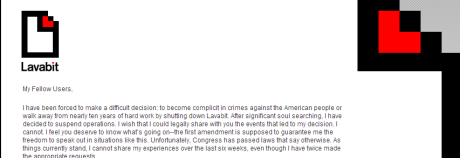


The front page of Lavabit announces to its users its decision to shut down rather than comply with ongoing US surveillance orders Photo: Lavabit


A Texas-based encrypted email service recently revealed to be used by Edward Snowden - Lavabit - announced yesterday it was shutting itself down in order to avoid complying with what it perceives as unjust secret US court orders to provide government access to its users' content. "After significant soul searching, I have decided to suspend operations," the company's founder, Ladar Levinson, wrote in a statement to users posted on the front page of its website. He said the US directive forced on his company "a difficult decision: to become complicit in crimes against the American people or walk away from nearly ten years of hard work by shutting down Lavabit." He chose the latter.

CNET's Declan McCullagh smartly speculates that Lavabit was served "with [a] federal court order to intercept users' (Snowden?) passwords" to allow ongoing monitoring of emails; specifically: "the order can also be to install FedGov-created malware." After challenging the order in district court and losing - all in a secret court proceeding, naturally - Lavabit shut itself down to avoid compliance while it appeals to the Fourth Circuit.

This morning, Silent Circle, a US-based secure online communication service, followed suit by shutting its own encrypted email service. Although it said it had not yet been served with any court order, the company, in a statement by its founder, internet security guru Phil Zimmerman, said: "We see the writing on the wall, and we have decided that it is best for us to shut down Silent Mail now."

What is particularly creepy about the Lavabit self-shutdown is that the company is gagged by law even from discussing the legal challenges it has mounted and the court proceeding it has engaged. In other words, the American owner of the company believes his Constitutional rights and those of his customers are being violated by the US Government, but he is not allowed to talk about it. Just as is true for people who receive National Security Letters under the Patriot Act, Lavabit has been told that they would face serious criminal sanctions if they publicly discuss what is being done to their company. Thus we get hostage-message-sounding missives like this:

"I wish that I could legally share with you the events that led to my decision. I cannot. I feel you deserve to know what's going on - the first amendment is supposed to guarantee me the freedom to speak out in situations like this. Unfortunately, Congress has passed laws that say otherwise. As things currently stand, I cannot share my experiences over the last six weeks, even though I have twice made the appropriate requests."

Does that sound like a message coming from a citizen of a healthy and free country? Secret courts issuing secret rulings invariably in favor of the US government that those most affected are barred by law from discussing? Is there anyone incapable at this point of seeing what the United States has become? Here's the very sound advice issued by Lavabit's founder:

"This experience has taught me one very important lesson: without congressional action or a strong judicial precedent, I would _strongly_ recommend against anyone trusting their private data to a company with physical ties to the United States."

As security expert Bruce Schneier wrote in a great Bloomberg column last week, this is one of the key aspects of the NSA disclosures: the vast public-private surveillance partnership. That's what makes Lavabit's stance so heroic: as our reporting has demonstrated, most US-based tech and telecom companies (though not all) meekly submit to the US government's dictates and cooperate extensively and enthusiastically with the NSA to ensure access to your communications.

Snowden, who told me today that he found Lavabit's stand "inspiring", added:

"Ladar Levison and his team suspended the operations of their 10 year old business rather than violate the Constitutional rights of their roughly 400,000 users. The President, Congress, and the Courts have forgotten that the costs of bad policy are always borne by ordinary citizens, and it is our job to remind them that there are limits to what we will pay.

"America cannot succeed as a country where individuals like Mr. Levison have to relocate their businesses abroad to be successful. Employees and leaders at Google, Facebook, Microsoft, Yahoo, Apple, and the rest of our internet titans must ask themselves why they aren't fighting for our interests the same way small businesses are. The defense they have offered to this point is that they were compelled by laws they do not agree with, but one day of downtime for the coalition of their services could achieve what a hundred Lavabits could not.

"When Congress returns to session in September, let us take note of whether the internet industry's statements and lobbyists - which were invisible in the lead-up to the Conyers-Amash vote - emerge on the side of the Free Internet or the NSA and its Intelligence Committees in Congress."

The growing (and accurate) perception that most US-based companies are not to be trusted with the privacy of electronic communications poses a real threat to those companies' financial interests. A report issued this week by the Technology and Innovation Foundation estimated that the US cloud computing industry, by itself, could lose between $21 billion to $35 billion due to reporting about the industry's ties to the NSA. It also notes that other nations' officials have been issuing the same kind of warnings to their citizens about US-based companies as the one issued by Lavabit yesterday:

"And after the recent PRISM leaks, German Interior Minister Hans-Peter Friedrich declared publicly, 'whoever fears their communication is being intercepted in any way should use services that don't go through American servers.' Similarly, Jörg-Uwe Hahn, a German Justice Minister, called for a boycott of US companies."

The US-based internet industry knows that the recent transparency brought to the NSA is a threat to their business interests. This week, several leading Silicon Valley and telecom executives met with President Obama to discuss their "surveillance partnership". But the meeting was - naturally - held in total secrecy. Why shouldn't the agreements and collaborations between these companies and the NSA for access to customer communications not be open and public?

Obviously, the Obama administration, telecom giants, and the internet industry are not going to be moved by appeals to transparency, privacy and basic accountability. But perhaps they'll consider the damage being done to the industry's global reputation and business interests by constructing a ubiquitous spying system with the NSA and doing it all in secret.

It's well past time to think about what all this reflects about the US. As the New York Times Editorial Page put it today, referencing a front-page report from Charlie Savage enabled by NSA documents we published: "Apparently no espionage tool that Congress gives the National Security Agency is big enough or intrusive enough to satisfy the agency's inexhaustible appetite for delving into the communications of Americans." The NYT added:

"Time and again, the NSA has pushed past the limits that lawmakers thought they had imposed to prevent it from invading basic privacy, as guaranteed by the Constitution."

I know it's much more fun and self-satisfying to talk about Vladimir Putin and depict him as this omnipotent cartoon villain. Talking about the flaws of others is always an effective tactic for avoiding our own, and as a bonus in this case, we get to re-live Cold War glory by doing it. The best part of all is that we get to punish another country for the Supreme Sin: defying the dictates of the US leader.

[Note how a country's human rights problems becomes of interest to the US political and media class only when that country defies the US: hence, all the now-forgotten focus on Ecuador's press freedom record when it granted asylum to Julian Assange and considered doing so for Edward Snowden, while the truly repressive and deeply US-supported Saudi regime barely rates a mention. Americans love to feign sudden concern over a country's human rights abuses as a tool for punishing that country for disobedience to imperial dictates and for being distracted from their own government's abuses: Russia grants asylum to Snowden --> Russia is terrible to gays! But maybe it's more constructive for US media figures and Americans generally to think about what's happening to their own country and the abuses of the own government, the one for which they bear responsibility and over which they can exercise actual influence.


Lavabit has taken an impressive and bold stand against the US government, sacrificing its self-interest for the privacy rights of its users. Those inclined to do so can return that support by helping it with lawyers' fees to fight the US government's orders, via this paypal link provided in the company's statement.

One of the most remarkable, and I think enduring, aspects of the NSA stories is how much open defiance there has been of the US government. Numerous countries around the world have waved away threats, from Hong Kong and Russia to multiple Latin American nations. Populations around the world are expressing serious indignation at the NSA and at their own government to the extent they have collaborated. And now Lavabit has shut itself down rather than participate in what it calls "crimes against the American people", and in doing so, has gone to the legal limits in order to tell us all what has happened. There will undoubtedly be more acts inspired by Snowden's initial choice to unravel his own life to make the world aware of what the US government has been doing in the dark.
 

hiddencloud

New member
Jan 1, 2011
227
0
0
twitter.com
All of this is why everyone should be wary to store any data that might be able to be used against them in the United States. "The cloud" is really popular these days but you have to remember where that information resides and that someone might be listening, no matter what promises the provider gives about privacy.
 

hiddencloud

New member
Jan 1, 2011
227
0
0
twitter.com
Yeah I have a home storage server device for all my data. Lots of Canadian businesses have been switching to cloud services for email and corporate document storage and I really think they're going to regret it within 10 years.
 

yazoo

New member
Dec 10, 2011
544
0
0
The only way to have true email security is to encrypt the email before it leaves your computer, and have the message decrypted on the recipient's computer. Then it doesn't matter what email service you use - the email body itself (but not the metadata) is always encrypted.

One way to do this is with certificates - but then you have to trust that nothing is compromised with the third party certificate system.

Another is with PGP, which does not depend upon a third party. I wish more people would use GnuPGP which is based upon the OpenPGP system. I would love to use it, but since almost nobody else is - I'd just be sending emails to myself.

A secure method of cloud storage is mega.co.nz which uses similar encryption techniques. You create and store the keys on your own computer and they have no method of obtaining them, no matter how much pressure is applied.
 

hiddencloud

New member
Jan 1, 2011
227
0
0
twitter.com
Having everyone encrypt their email would be ideal but the problem is that no one cares enough to do it.

That's why this NSA stuff will eventually blow over. No one really cares enough in the long run.
 

Miss*Bijou

Sexy Troublemaker
Nov 9, 2006
3,131
44
48
Montréal
..
..​

If anyone's interested in learning how to encrypt their emails..


How to Encrypt Your Email and Keep Your Conversations Private


Between constant password breaches and the NSA looking in on everything you do, you've probably got privacy on the mind lately. If you're looking for a little personal privacy in your communications with friends and loved ones, or you just want to trust that the documents you email to your accountant or client aren't being intercepted and read, you'll need to encrypt those messages. Thankfully, it's easy to do. Here's how.


Why You Should Encrypt Your Email


While government spying is on everyone's mind right now, it's really just the most recent security distraction to make headlines. Before everyone was angry at the NSA (and no, it's unlikely that PGP encryption will protect your emails from the NSA, although there are plenty of examples of law enforcement unable to break PGP encryption, and then trying to force them to hand over their keys), we were angry at corporate snooping, employers reading personal emails, identity thieves, and hackers. While encrypting your email may or may not protect you from a major government or someone with significant time and processing resources, it can definitely keep your data safe from people looking to hijack your accounts, reset passwords and then log in as you, steal financial data, or comb through your contacts looking for useful information about you for spear-phishing attacks.

In this post, we'll walk you through how to encrypt your email using desktop clients including Thunderbird and Postbox, and how to encrypt almost any webmail provider you use (Gmail, Outlook, Google Apps, Yahoo, etc). All you need is a few downloads and a little setup time. Of course, you'll also need friends who also use PGP, since you'll have to exchange public keys with them to make sure they can read your messages.

We've explained several times why your privacy is important, and even if you're not concerned with government spying (which doesn't even require a warrant) or corporate tracking (which you may have unwittingly opted into when you signed up for free email), there are several good reasons to make sure you secure and encrypt some of your sensitive communications.

We can hear you now. You may be wondering why you should bother. "Privacy is dead!" "They're collecting all your data anyway." "Using stuff like this makes you more likely to be targeted." While big government agencies and companies looking to sell you advertising are the first things that come to mind when most people think of internet privacy, they're by no means the only parties interested in your personal data, and you shouldn't behave like they are. It's the more mundane threats and issues that are likely to ruin your day.

Bank statements, contracts, confidentiality agreements or non-disclosure forms, job offers, financial records, medical histories, lab test results; these are all just a few types of information that should—and in many cases are legally required—to stay private. Beyond that, the argument that using security tools somehow invites scrutiny plays to people's fears and encourages them to do nothing. It's not the government or a big tech company that will take advantage of that fear and complacency either, it's the common identity thief, a spear-phisher looking for something they can use or sell, or someone sniffing packets on public Wi-Fi for the sake of curiosity.


Getting Started: How PGP Encryption Works, and What You'll Need

Go Here For The Full Text & Tutorial: Link
 

Miss*Bijou

Sexy Troublemaker
Nov 9, 2006
3,131
44
48
Montréal
..​

They should listen to this advice...


Source


The NSA Is Commandeering the Internet
Technology companies have to fight for their users, or they'll eventually lose them.


It turns out that the NSA's domestic and world-wide surveillance apparatus is even more extensive than we thought. Bluntly: The government has commandeered the Internet. Most of the largest Internet companies provide information to the NSA, betraying their users. Some, as we've learned, fight and lose. Others cooperate, either out of patriotism or because they believe it's easier that way.

I have one message to the executives of those companies: fight.

Do you remember those old spy movies, when the higher ups in government decide that the mission is more important than the spy's life? It's going to be the same way with you. You might think that your friendly relationship with the government means that they're going to protect you, but they won't. The NSA doesn't care about you or your customers, and will burn you the moment it's convenient to do so.

We're already starting to see that. Google, Yahoo, Microsoft and others are pleading with the government to allow them to explain details of what information they provided in response to National Security Letters and other government demands. They've lost the trust of their customers, and explaining what they do -- and don't do -- is how to get it back. The government has refused; they don't care.

It will be the same with you. There are lots more high-tech companies who have cooperated with the government. Most of those company names are somewhere in the thousands of documents that Edward Snowden took with him, and sooner or later they'll be released to the public. The NSA probably told you that your cooperation would forever remain secret, but they're sloppy. They'll put your company name on presentations delivered to thousands of people: government employees, contractors, probably even foreign nationals. If Snowden doesn't have a copy, the next whistleblower will.

This is why you have to fight. When it becomes public that the NSA has been hoovering up all of your users' communications and personal files, what's going to save you in the eyes of those users is whether or not you fought. Fighting will cost you money in the short term, but capitulating will cost you more in the long term.

Already companies are taking their data and communications out of the US.

The extreme case of fighting is shutting down entirely. The secure e-mail service Lavabit did that last week, abruptly. Ladar Levison, that site's owner, wrote on his homepage: "I have been forced to make a difficult decision: to become complicit in crimes against the American people or walk away from nearly ten years of hard work by shutting down Lavabit. After significant soul searching, I have decided to suspend operations. I wish that I could legally share with you the events that led to my decision."

The same day, Silent Circle followed suit, shutting down their email service in advance of any government strong-arm tactics: "We see the writing the wall, and we have decided that it is best for us to shut down Silent Mail now. We have not received subpoenas, warrants, security letters, or anything else by any government, and this is why we are acting now." I realize that this is extreme. Both of those companies can do it because they're small. Google or Facebook couldn't possibly shut themselves off rather than cooperate with the government. They're too large; they're public. They have to do what's economically rational, not what's moral.

But they can fight. You, an executive in one of those companies, can fight. You'll probably lose, but you need to take the stand. And you might win. It's time we called the government's actions what it really is: commandeering. Commandeering is a practice we're used to in wartime, where commercial ships are taken for military use, or production lines are converted to military production. But now it's happening in peacetime. Vast swaths of the Internet are being commandeered to support this surveillance state.

If this is happening to your company, do what you can to isolate the actions. Do you have employees with security clearances who can't tell you what they're doing? Cut off all automatic lines of communication with them, and make sure that only specific, required, authorized acts are being taken on behalf of government. Only then can you look your customers and the public in the face and say that you don't know what is going on -- that your company has been commandeered.

Journalism professor Jeff Jarvis recently wrote in The Guardian: "Technology companies: now is the moment when you must answer for us, your users, whether you are collaborators in the US government's efforts to 'collect it all' -- our every move on the internet or whether you, too, are victims of its overreach."

So while I'm sure it's cool to have a secret White House meeting with President Obama -- I'm talking to you, Google, Apple, AT&T, and whoever else was in the room -- resist. Attend the meeting, but fight the secrecy. Whose side are you on?

The NSA isn't going to remain above the law forever. Already public opinion is changing, against the government and their corporate collaborators. If you want to keep your users' trust, demonstrate that you were on their side.
 

Miss*Bijou

Sexy Troublemaker
Nov 9, 2006
3,131
44
48
Montréal

According to a prominent security analyst, technology exists that could've allowed someone to hack his car. Former U.S. National Coordinator for Security, Infrastructure Protection, and Counter-terrorism Richard Clarke told The Huffington Post that what is known about the single-vehicle crash ( in which journalist Michael Hastings' died - in Los Angeles) is "consistent with a car cyber attack."

Clarke said, "There is reason to believe that intelligence agencies for major powers" -- including the United States -- know how to remotely seize control of a car.

"What has been revealed as a result of some research at universities is that it's relatively easy to hack your way into the control system of a car, and to do such things as cause acceleration when the driver doesn't want acceleration, to throw on the brakes when the driver doesn't want the brakes on, to launch an air bag," Clarke told The Huffington Post. "You can do some really highly destructive things now, through hacking a car, and it's not that hard."

"So if there were a cyber attack on the car -- and I'm not saying there was," Clarke added, "I think whoever did it would probably get away with it."

...

http://www.huffingtonpost.com/2013/06/24/michael-hastings-car-hacked_n_3492339.html


And this is how easy it is and what it looks like...


<iframe width="640" height="360" src="//www.youtube.com/embed/oqe6S6m73Zw" frameborder="0" allowfullscreen></iframe>

http://www.forbes.com/sites/andygre...w-car-attacks-with-me-behind-the-wheel-video/


<iframe width="640" height="360" src="//www.youtube.com/embed/hqKafI7Amd8" frameborder="0" allowfullscreen></iframe>
 
Ashley Madison
Vancouver Escorts