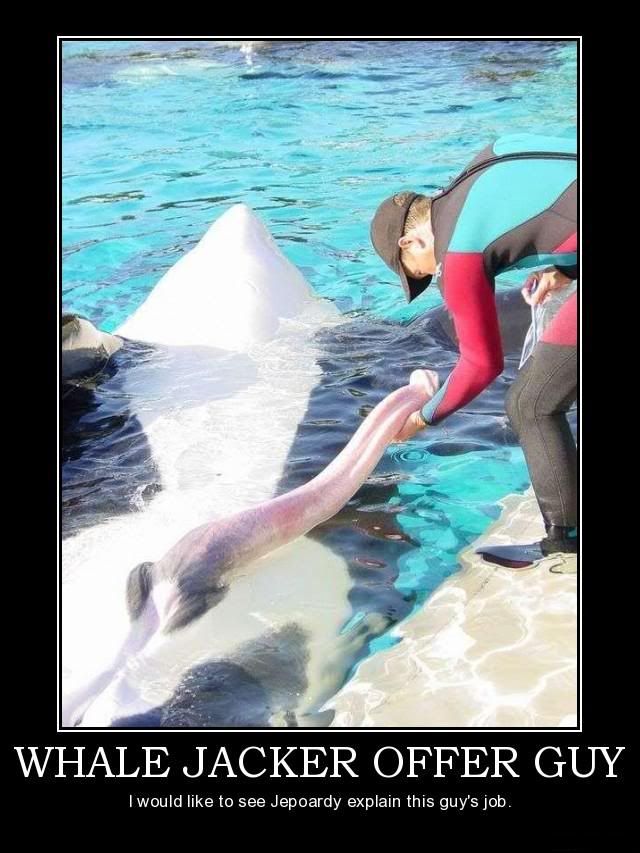
Hilarious jab at PETA on the Daily Show (link to video)

Holly Taylor

New member
May 27, 2007
405
9
0
Vancouver
Did anyone see this show from a few days ago? I thought it was extremely well done.

Now, I am a very avid supporter of animal rights, and I adjust my diet accordingly.

This video (a clip from the Daily Show with Jon Stewart) does a very good job of attacking a very offensive position taken by PETA recently. During Black History month, they compare whales in captivity to African-American slaves?? Come on now!

http://www.youtube.com/watch?v=gPkuuu5-pfU
 

storm rider

Banned
Dec 6, 2008
2,542
7
0
Calgary
Yeah that was hilarious!!

As for the Whales......I don't know about freeing whales that are already in captivity. I'm not sure they would survive in the wild.
OK I totally agree that the Daily Show skit was fricken hilarious....I relly enjoyed it.

As for P.E.T.A launching a lawsuit against aqauriums that are treating Orca's like slaves....well that is a total fucking joke.....are those big ass funky black&white mammals being tasered to learn the tricks they perform....nope.....if those gigantic creatures truly hated the captivity of said aqauriums I think they would have taken one of the un-countable opportunities to chomp one of the trainers who frolick with them...keep in mind the Orca is the only whale that actually has teeth...very large teeth at that.

With this in mind P.E.T.A slips down a rung on the ladder....they are now below scientologists.

SR
 

Holly Taylor

New member
May 27, 2007
405
9
0
Vancouver
.if those gigantic creatures truly hated the captivity of said aqauriums I think they would have taken one of the un-countable opportunities to chomp one of the trainers who frolick with them...keep in mind the Orca is the only whale that actually has teeth...very large teeth at that.
I don't actually know anything about the situation of captive aquarium whales/dolphins/other creatures. If there was an animal cruelty or abuse concern, I would definitely want it to be investigated. But comparing these concerns to the slavery of African-Americans - arrrggg!!!! No!!
 

uncleg

Well-known member
Jul 25, 2006
5,652
839
113
PETA does tend to go overboard sometimes.....................................


..........................but you have to admit, some of their shit is spot on.....................


...........:p:p:p:p:D
 

Miss*Bijou

Sexy Troublemaker
Nov 9, 2006
3,132
44
48
Montréal
I will butt in here to add a few clarifications about the topic. Storm rider really has no interest in forming his opinions on facts or considering there might be some things he doesn't know or realize but I'm also convinced the opposite is true for Holly and she's open to hearing about it if there are some things she's not aware of, which is why I'm going to add my 2 cents about this issue. I could not care less that storm rider will preach out of complete ignorance.


First I want to say that in the case of whales but also of great many other animals, science has only recently started to reveal how much we have under estimated animals capacity for such things as reasoning, self , emotions, complex thinking, problem solving emotional lives, culture, intelligence and that we have a lot more in common than we had imagined.


I mention that because I think it is generally not known and that most of us assume that what we believe about animals is the accepted representation and therefore all of our views on animal issues always start from that erroneous belief. In reality, that could not be a more incomplete and out dated representation - presumably what is known about animals, which is wildly different than what majority of us believe, probably simply hasn't crossed over yet.


It is available to anyone who seeks it out. Without intentionally pursuing it out of personal interest or curiosity, and never being exposed to it, most people never realize there is a lot more to consider when it comes to other species. I think that is the biggest problem when discussing anything that relates to animals and our treatment of them. I don't think it's possible to really consider what is at stake and why some opinions and positions appear so extreme without first realizing what implications these findings have. Someone who comments like storm rider is the ultimate example of this:


One of his very first cocky responses to an animal issue on one of the first threads I posted about it when I started realizing I had been missing a huge part of the picture and started to inform myself, was some absurd justification why it was obviously "normal" to eat pigs, implying that this is what they were for, that they were just dumb animals - while it was not okay to eat dogs, that dogs were meant to be pets because they're smart.


What he clearly didn't even consider is that his opinions and beliefs might be based on nothing more than assumptions he'd never questioned and that in reality, even if it was unquestioningly evident to him that this was completely accurate, if he'd ever really tried to confirm that assumption, he would have found out that pigs are known to be quite intelligent – in fact, as intelligent, if not more so, than dogs.


Now I don't happen to think that even makes a difference in the argument, or that an animal that may be deemed to be less or more intelligent based on our criteria, might make a difference on the morality or justification of eating one over the other - but even if I ignore that, his comment epitomized our tendency to lend credibility to beliefs we accept without ever questioning their accuracy for ourselves.


And this isn't just storm rider, that's most of us. I cannot even explain how disturbed I was by that when I personally realized how I'd been completely ignorant and how much of an effect it had on my beliefs and my choices. It completely changed my perspective or the way I saw these issues. And that's why I honestly think that people need to take the initiative to seek out the information and make sure that what they believe is accurate. Otherwise it tends to invalidate any opinion, belief or claim they make, as it's based on something that is simply wrong to begin with.


I'm telling you - it completely changes the discussion.


Call of the Killer Whale - PBS Jean-Michel Cousteau: Ocean Adventures


Miss*Bijou

Sexy Troublemaker
Nov 9, 2006
3,132
44
48
Montréal
Now, on the topic of this thread specifically - I just wanted to add that in all fairness to PETA, this is not quite what the situation is about. I think the way it’s been reported is a little misleading and misrepresents what actually did happen. PETA, as far as I know, never made any comparison to African American slaves nor did Black history month have anything to do with this whole trainwreck.


What they did do was file a lawsuit against Sea World that concerned the last 5 whales that were caught in the wild (all the others are captive bred - and very inbred at that). The lawsuit was filed in Oct 2011 but the court dates and the judge’s ruling happened to be delivered in the month of February. He ruled to dismiss based on the fact that legally speaking, whales are not persons and therefore the part of the Constitution pertaining to slavery could not apply to them - legally..


But Peta never planned this specifically during that month, nor did they expressly make such a comparison. IMO, that paints a slightly different picture than what the accusations have implied, no?


Legally, that did not work because legally whales are not persons and the Constitution as well as the legal system, applies to persons. That is why Peta's approach had been much criticized also by other organisations working for animals, as they believed it is first necessary to establish non human animals as persons in the eyes of the law (hey - corporations are persons in the eyes of the law, so it should not be too far fetched to allow it to apply to non human animals).


In any case, other organisations have criticized PETA's move – but for very different reasons. I feel the problem with PETA’s lawsuit is not in their use of the word slavery in reference to whales in captivity and I agree with the criticism voiced by The Non Human Rights Project:


The Nonhuman Rights Project today issued the following press release:

Feb 8th, 2012: Seventy-two hours after hearing oral argument on SeaWorld’s Motion to Dismiss PETA’s case, the Federal Court in San Diego dismissed PETA’s claims that the plaintiff orcas were enslaved within the meaning of the Thirteenth Amendment, with prejudice, on the ground that the Court lacked subject matter jurisdiction, as the plaintiffs lacked standing.

The judge also ruled, in a seven-page decision, that the Thirteenth Amendment applies only to humans and only to persons, and that orcas are not legal persons. He said that, unlike the Fourteenth Amendment, the Thirteenth Amendment should not be expansively interpreted.

When PETA filed the suit in October, 2011, the Nonhuman Rights Project (NhRP) immediately recognized that the suit was premature and ill-conceived, and that PETA was ill-prepared. That is why the NhRP asked the federal judge for leave to appear as an amicus curiae, or “Friend of the Court.” The judge allowed its motion. But there was little it could accomplish. PETA had already filed the wrong suit in the wrong court.

“We hope PETA will realize that it embarked on a fool’s errand,” said NhRP President Steven Wise. “PETA wrongly believed it did not need to prove that an orca was a legal person, so it failed to be ready to prove that an orca is a “person.” Worse, it actually opposed our legal arguments that an orca is indeed a “person”, thus creating a roadblock that we will have to overcome in the future.”

PETA can inflict further damage to the rapidly-emerging discipline of animal rights jurisprudence by appealing to the Ninth Circuit Court of Appeals. We can only assume that SeaWorld, along with every other exploiter of nonhuman animals, is hoping that they will.

The Nonhuman Rights Project calls on PETA to let bad enough alone.


http://www.nonhumanrightsproject.or...case-against-seaworld-nhrp-weighs-the-damage/


Conservationist Philippa Brakes said she fully agrees that holding large-brained mammals in captivity in a situation where they are harming themselves because of their misery “amounts to slavery.” But she said that most of the public would probably not see it that way. The report says:

While the case would bring publicity to the issue of the rights or interests of “non-human persons”, something for which some people have been arguing for a long time, if the case fails and there is then case law history against recognizing those rights, that would not be helpful for the cause, Brakes warned.

“I would love to be wrong, and that they find for the orcas in this case, but I doubt very much that’s going to happen, and I think it’s a strategic error,” she said.

Brakes said she does believe that “a tipping point is coming” and that the growing evidence from science is moving us toward that tipping point.

“It’s more than court cases,” she said. “It’s really about changing people’s attitudes and understanding.”


http://www.guardian.co.uk/world/2012/feb/05/seaworld-whales-enslavement-legal-challenge

This has an overview of the arguments from both sides about orcas and the law:

http://www.nonhumanrightsproject.org/2012/02/07/peta-and-seaworld-square-off-at-court-hearing/


There is a lot of merit to the case against whales in captivity. I hope you'll take some time to look into when you get a chance. I'm sure you'll agree that even though Peta's approach was not the best, there is no doubt as to the importance of this issue. This is not just an extremist, or fringe animal rights activists issue, there are a great number of respected scientists with decades of experience, in this specific field who are directly involved, are very vocal and loud about the seriousness and importance of looking into this.


Here are some good places to get the information relating to this issue:


(This is one of the most informative websites about orcas in captivity, Seaworld, etc..)

http://theorcaproject.wordpress.com


About Sea World, the captures and how they were outlawed in the U.S.:


Up until the capture of orcas was outlawed in BC and Washington, an incredible number of whales were caught and either died or made captive.

http://www.orcahome.de/impact.htm


About orcas

http://www.google.com/notebook/html?nbid=BDQjwDAoQpLXK6Nol


This is a great movie about whales in captivity.


A Fall from freedom
http://afallfromfreedom.org


<iframe src="http://player.vimeo.com/video/26338045?title=0&byline=0&portrait=0&color=ffffff" width="400" height="300" frameborder="0" webkitAllowFullScreen mozallowfullscreen allowFullScreen></iframe><p><a href="http://vimeo.com/26338045">A Fall From Freedom</a> from <a href="http://vimeo.com/odyseetv">OdyseeTV</a> on <a href="http://vimeo.com">Vimeo</a>.</p>


This site is maintained by scientists who study orcas in the wild in Puget sound (Washington state) - they study a population called the Southern Residents (the population in BC waters is called the Northern Residents) but they have been active in a campaign to free one of those 5 remaining wild caught orcas, who was taken as an infant from this population of orcas. Now that more in known about the individuals and pods, these scientists have determined which family she originated from. They have been working to Free this orca (Lolita) who has been alone without any other orca, in Miami for decades.

http://orcanetwork.org/captivity/captivity.html


More info about Lolita's life:

http://theorcaproject.wordpress.com...a-her-life-her-legal-issues-and-her-way-home/

http://www.thedailybeast.com/newsweek/2008/01/22/free-lolita-a-whale-story.html


This is a movie about Lolita's story.


Lolita the killer Whale: Slave to entertainment
http://www.slavetoentertainment.com/


Corky is another one of those last 5 wild caught orcas who has spent close to 40 years in captivity. She is from the Northern Residents pod - from BC.

http://www.orcalab.org/corky-a16/corky_story/corkys_capture/index.htm


As far as what is being recommended for the orcas, it is certainly not that they all simply be released in the wild. Lolita is a special case because the population she was taken from has been studied since then. However, this is not the case for the animals that were taken from Icelandic waters and it is not known which pod or family they originated from. Generally speaking, the consensus is that if it is determined (by the scientists) that an orca is not a candidate for release into the wild, they would be moved to special sea pens that would at least allow for room to travel and engage in normal behavior. Certainly it would mean no longer putting them on display to perform silly unatural tricks or being confined in small chlorinated pools with unrelated whales, with nothing to do and nowhere to go.


It certainly would not involve being masturbated to provide sperm to create more captive whales to exploit.


Howard Garrett of Orca Network describes historical events and recent developments in the public's perception of the practice of holding orcas in captivity for entertainment revenue.


As far as captive born orcas, release into the wild is most likely out of the question, for one because they would most likely lack the skills or knowledge necessary but also because they have no pod to be returned to. Nevermind that many of them are "hybrids" (mix of Southern resident and orca from Icelandic waters - which would never occur in the wild, as these orcas would never meet, let alone mate and one is a fish eating orca while the other is a marine mammal eating orca). I believe they would be relocated to sea pens or something similar.


There would be no more breeding whatsover between any of the whales, unlike at Sea World where the monetary incentive to produce more whales has meant irresponsible inbreeding and unrealistic pairings. When the last whales died, the only whales alive from then on would be wild. There would no longer be a captive whale population, period.

There's more complexity to the orca social structure and differences between populations but you can find a lot more in the videos and links I'm including.


Sea World has indeed been accused in relation to the orcas they "own" but it has not been regarding concerns for the orcas themselves (laws and enforcement are lacking and - what else is new!) but rather in regards to the safety of their employees/trainers. Following the deaths of 2 trainers within a few months in 2010, they were cited and fined for failing to ensure the safety of their employees. They decided to fight the decision in court (ongoing) as they were forced to modify their shows and stop the parts that involved the trainers interacting in the water with the orcas.


Unsurprisingly this is a problem for Sea World, as that is the favorite part for the spectators....the ones paying Sea World.


Miss*Bijou

Sexy Troublemaker
Nov 9, 2006
3,132
44
48
Montréal

Can an animal be a slave?


Is the confinement of animals for human purposes akin to slavery? Are some animals slaves?

Slavery is an evocative concept. Treating someone as a slave is one of the worst things you can do to them. Using the term “slavery” brings with it considerable rhetorical force. It’s attention grabbing. It’s an expression that is likely to resonate with people, irrespective of whether they agree with the underlying political point being made.

Given its emotive force, it’s not surprising that a publicity-savvy group like PETA would try to draw attention to the plight of animals in captivity by drawing parallels with human slavery. They last week went to court, accusing Sea World of enslaving orcas used in one of its shows. The judge dismissed the case, ruling that PETA’s invoking of the term “slavery” was at odds with its “historical and contemporaneous” usage.

One could side with the judge in the Sea World case and say that PETA was being a little sneaky in trying to make a political point by trading on an ambiguity around the meaning of the term “slave”. In this view, when someone compares captive animals to slaves, they are misapplying the term slave: this is a term that ought to be reserved for persons only. But what do they mean by “person”?

A person is an individual, most likely a human being, who possesses a sophisticated psychology above a threshold level of complexity marked by specific capacities, such as an ability to reflect upon one’s thinking and life choices, to make judgments on the basis of evidence, to understand concepts such as right and wrong, life and death, and so on.

A person can be held morally responsible for their actions. The basic idea is that persons are authors of their own lives in a way that non-persons, like animals, are not.

For proponents of this view, slavery is an evil because it amounts to taking over the authorship of a life, and animals cannot be slaves because they lack the necessary psychological capacities to self-consciously direct their lives.

But, setting aside disputes about the scope of personhood capacities in the natural world, should the meaning of slavery be restricted to persons only? Is there anything wrong with applying the term slavery to animals in order register one’s opposition to how they are being treated or to draw attention to their plight?

I used to live in a country town not far from Sydney. On most evenings my wife and I would enjoy a stroll around the neighbourhood, breathing the fresh country air and enjoying the beautiful surrounds. On occasion we would pass the house of a Jack Russell breeder who kept bitches in small wire enclosures in his garage. We know this because very occasionally the door to the garage would be open.

Now it makes sense to me to say, in response to what I saw, that “the dogs are being kept as slaves”. It also makes sense to me to say that keeping animals in this way, ostensibly for their reproductive use, is akin to slavery or a form of slavery.

Similarly, not far from where I live now, a cockatoo is kept in a cage not much bigger than its body. We often hear this cockatoo screeching as we walk past. I personally find the sight of birds in cages distressing. My view is that there is something ignoble in the desire to look upon a caged creature that is built for flying through the sky as if it were a living figurine. I think the world would be a better place if people could express their fascination or love for animals without confining them.

Now, in light of my disapproval of caged birds, I think it makes sense for me say to that the cockatoo should be “set free”. People know perfectly well what I mean when I say this.

But, again, some might take issue with my use of the term “set free”. They may point out that when someone says a bird should be “set free” this is very different to saying that a slave should be “set free”. When a bird is set free it’s no longer subject to physical or bodily constraint; whereas for a slave, “set free” means no longer having your life directed by another’s lights.

I recall seeing a harrowing news feature about a female orangutan kept for sex by villagers in Indonesia. An NGO had made many attempts to rescue the creature, but had been shot at by the villagers who considered the ape their property. Again, isn’t this a case when it seems appropriate to say that the animal is being treated as a slave, in this case a sex slave?

If I was to talk about confining animals with my friends or colleagues, and in the process use terms like “slavery” or “freedom”, I’m guessing that the conversation would be perfectly intelligible, possibly even thought-provoking. It is very unlikely to come to an abrupt end because of some kind of conceptual confusion. What better evidence for correct application of a term can you have then successful communication between people?

Some might say that what’s wrong about using the terms “animal” and “slavery” in the same sentence is that it downplays the seriousness of slavery. But not all that is wrong about slavery needs to apply to the keeping of animals in order for us to think that the term can be meaningfully applied across the species barrier.

After all, slaves are the legal property of their owners; animals are legal property. Slaves are subject to the absolute authority of their owners; so are animals. Slave owners command obedience; obedience is a concept readily applied by owners to their animals. Slaves are kept in bondage; many orcas, Jack Russells, cockatoos and oranutans are confined 24/7.

Perhaps then we should view PETA’s strategy not so much as sneaky but as signalling how our views about the evil of slavery may no longer be so “person-centric”, and how we can discuss hitherto unquestioned instances of keeping animals in a new and engaging way.


http://theconversation.edu.au/can-an-animal-be-a-slave-5268


Pulling back the curtain – questioning our culture of captivity


http://www2.wdcs.org/blog/index.php...-question-our-culture-of-captivity.html#c2177


Whales and dolphins 'should have legal rights'

http://www.guardian.co.uk/world/2012/feb/21/whales-dolphins-legal-rights?newsfeed=true


The Dolphin Dealer

http://www.cbc.ca/documentaries/doczone/2008/dolphindealer/

http://www.cbc.ca/video/#/Shows/Doc_Zone/1242299559/ID=1234713011 (video)


The Woman who swims with killer whales

http://www.watchseries-online.eu/20...5-the-woman-who-swims-with-killer-whales.html


The cultural life of whales

http://www.guardian.co.uk/science/2011/jan/30/whales-philip-hoare-hal-whitehead


The Cove

http://topdocumentaryfilms.com/cove/


The Ultimate Guide Whales

http://www.56.com/u83/v_MzU3OTI1NzY.html


Whales (IMAX)

http://www.youtube.com/playlist?list=PL167DD25F3DB8A6BC
 

Very Veronica

Banned
Aug 2, 2004
1,766
7
0
Vancouver
I'm with Bijoux. Didn't find it hilarious at all, on the contrary it's not funny. Love to hear Jon Stewart's veggie pal Bill Maher's thoughts.
 

Holly Taylor

New member
May 27, 2007
405
9
0
Vancouver
I'm very interested in discussing issues of animal captivity and animal cruelty. I made huge changes to my diet after learning about the conditions of factory farms, and how animal products are produced, and where everything comes from.

But I can't get on board comparing captive whales to African-American slavery, and I think Jon Stewart had a point by calling them out on the comparison.

I'll definitely look at all those links, Bijou. Thank you for posting them. A thank you for considering me a person who likes to look into facts. I consider myself such a person, and I will set aside some time to do more thinking on the topic.
 

Miss*Bijou

Sexy Troublemaker
Nov 9, 2006
3,132
44
48
Montréal


Source:http://news.nationalpost.com/2012/02/21/dolphins-deserve-rights-scientists-told/


The declaration...


Source:http://www2.wdcs.org/blog/


IMO it's not a huge leap to add "species" as a difference used to justify enslaving another sentient being...


<a title="View Orca White Paper on Scribd" href="http://www.scribd.com/doc/82508491/Orca-White-Paper" style="margin: 12px auto 6px auto; font-family: Helvetica,Arial,Sans-serif; font-style: normal; font-variant: normal; font-weight: normal; font-size: 14px; line-height: normal; font-size-adjust: none; font-stretch: normal; -x-system-font: none; display: block; text-decoration: underline;">Orca White Paper</a><iframe class="scribd_iframe_embed" src="http://www.scribd.com/embeds/82508491/content?start_page=1&view_mode=list&access_key=key-269hus1rmwjcowm9rwk8" data-auto-height="true" data-aspect-ratio="0.772727272727273" scrolling="no" id="doc_37377" width="100%" height="600" frameborder="0"></iframe><script type="text/javascript">(function() { var scribd = document.createElement("script"); scribd.type = "text/javascript"; scribd.async = true; scribd.src = "http://www.scribd.com/javascripts/embed_code/inject.js"; var s = document.getElementsByTagName("script")[0]; s.parentNode.insertBefore(scribd, s); **)();</script>
 
Last edited:

Miss*Bijou

Sexy Troublemaker
Nov 9, 2006
3,132
44
48
Montréal
I'll definitely look at all those links, Bijou. Thank you for posting them. A thank you for considering me a person who likes to look into facts. I consider myself such a person, and I will set aside some time to do more thinking on the topic.

Awesome. :thumb::)


Do Orcas At Marine Parks Injure One Another?
http://timzimmermann.com/2010/09/14/do-orcas-at-marine-parks-injure-one-another/
http://timzimmermann.com/2011/01/31/do-orcas-at-marine-parks-injure-one-another-more-photos/


Two Former Orca Trainers Document The Deadly Stresses Of Captivity
http://timzimmermann.com/2011/01/24...rs-document-the-deadly-stresses-of-captivity/


Department of Revealing Moments: False Killer Whale Jumps Out Of Tank


This YouTube video has been getting a lot of views, because it does what all good video does: it makes you sit up, take notice, and think.


We can’t know what that false killer whale (Pseudorca crassidens) is thinking, but it’s definitely not: “I like it in here, I think I’ll stay.”

During my reporting for The Killer In The Pool I heard stories of killer whales that had jumped out of the pool, particularly a SeaWorld orca called Kotar, who was moved from Orlando to San Antonio after he bit the penis of another male (what would Freud say?). Kotar eventually died after a pool gate he was playing with closed on him and crushed his head.

Does anyone know the facts about Kotar, or of other videos or stories about dolphins and killer whales jumping out of their pools?

The video story of the incident above continues (interesting to note the reaction of the other animals). You can bet the audience left that park wondering about many things.


http://timzimmermann.com/2010/07/14/department-of-revealing-moments-dolphin-jumps-out-of-tank/


Are Wild Orca Captures About To Begin Again?
http://timzimmermann.com/2011/02/15/are-wild-orca-captures-about-to-begin-again/


MARINE MAMMALS -KEEP WHALES WILD
http://www.zoocheck.com/marineparks.html


The Price Dolphins Pay to Entertain Us
http://www.bluevoice.org/news_dolphinshow.php

expose:
http://www.bluevoice.org/Videos/expose.mov

more videos:
http://www.bluevoice.org/webfilms_dolphincaptivity.php#listofvideos


The Cove (full movie)

<object width="410" height="341" id="veohFlashPlayer" name="veohFlashPlayer"><param name="movie" value="http://www.veoh.com/swf/webplayer/WebPlayer.swf?version=AFrontend.5.7.0.1331&permalinkId=v21039139fJsy8wbf&player=videodetailsembedded&videoAutoPlay=0&id=anonymous"></param><param name="allowFullScreen" value="true"></param><param name="allowscriptaccess" value="always"></param><embed src="http://www.veoh.com/swf/webplayer/WebPlayer.swf?version=AFrontend.5.7.0.1331&permalinkId=v21039139fJsy8wbf&player=videodetailsembedded&videoAutoPlay=0&id=anonymous" type="application/x-shockwave-flash" allowscriptaccess="always" allowfullscreen="true" width="410" height="341" id="veohFlashPlayerEmbed" name="veohFlashPlayerEmbed"></embed></object><br /><font size="1">Watch <a href="http://www.veoh.com/watch/v21039139fJsy8wbf">The Cove</a> in <a href="http://www.veoh.com/browse/videos/category/activism_non_profit">Activism & Non-Profit</a> | View More <a href="http://www.veoh.com">Free Videos Online at Veoh.com</a></font>
 
Last edited:

Miss*Bijou

Sexy Troublemaker
Nov 9, 2006
3,132
44
48
Montréal
next thing you know..we'll be promoting insect rights, what about virus rights?
Are you comparing virus and insects to whales and dolphins to make your argument against giving some basic rights to cetaceans - such as the right to freedom and to not be held captive in unnatural environment for the purpose of being exploited for profit for their entire lives?

Really?


more important matters at hand, such as overpopulation, sustainbility, social inequality.
I wasn't aware there was a competition or a need to choose one over another because of some kind of limit to how many matters warrant our attention and change.

Those are all topics I've posted about in the past and feel are important but that doesn't mean cetaceans' rights to such a basic right as freedom from exploitation are automatically out of the question because I feel those are important issues. That's not how it works.. and actually, it's probably all interconnected to begin with IMO -

If we can't respect the other animals on this planet and continue to insist on keeping our old, outdated, arrogant belief that we are superior to all other life and that we are justified in doing whatever we please simply because it is profitable for someone or because it benefits us in some way, then we will never decide to treat all humans equally. we will never acknowledge that the laws of nature that apply to all eco systems apply to us as well or that we need to to take responsibility for the way we exploit this planet.

This is why one is not more important or deserving of our attention but they all are because you can't expect one of these matters to be addressed or resolved without the others being as well.


I'm with Bijoux. Didn't find it hilarious at all, on the contrary it's not funny. Love to hear Jon Stewart's veggie pal Bill Maher's thoughts.

 
Last edited:

Miss*Bijou

Sexy Troublemaker
Nov 9, 2006
3,132
44
48
Montréal
Sorry but those comments are just too stupid to ignore...


are those big ass funky black&white mammals being tasered to learn the tricks they perform....nope.....if those gigantic creatures truly hated the captivity of said aqauriums I think they would have taken one of the un-countable opportunities to chomp one of the trainers who frolick with them...

"Aggression expressed by killer whales toward their trainers is a matter of grave concern. Show situations involving water behaviors with trainers and orcas have become popular in recent years. Aggressive manifestations toward trainers have included bumping, biting, grabbing, dunking, and holding trainers on the bottom of pools preventing their escape. Several situations have resulted in potentially life-threatening incidents. In a few such cases, we can attribute this behavior to disease or to the presence of frustrating or confusing situations, but in other cases, there have been no clear casual factors." - Marine mammal veterinarian Jay Sweeney


SeaWorld has repeatedly failed to document incidents of aggression displayed by killer whales toward animal trainers, lawyers for the federal government charged Wednesday.

The log includes reports of 100 incidents: 98 of them from SeaWorld parks and two from Loro Parque, a Canary Islands marine park that houses some of SeaWorld's whales.

"If it had happened from 1988 to now, all incidents are in this notebook," said Chuck Tompkins, corporate curator of zoological operations for SeaWorld Parks & Entertainment, the parent company of SeaWorld marine parks in Orlando, San Diego and San Antonio.

But using separate internal documents — animal profiles that include the behavioral history for each of SeaWorld's roughly two-dozen killer whales — OSHA pointed out events that were never included in the incident-report log, including one in which a whale lunged into a trainer. OSHA cited five incidents taken from a single whale profile that were not included in the incident-report log.

"So, in fact, what you're calling a complete incident report log is not complete and does not contain every incident between 1988 and 2009, correct?" U.S. Department of Labor lawyer John Black asked.

"We missed a few," Tompkins responded.

http://articles.orlandosentinel.com..._dawn-brancheau-seaworld-trainers-loro-parque


On December 24, 2009, a 6,600-pound orca killed trainer Alexis Martínez at a marine park in the Canary Islands. Two months later, trainer Dawn Brancheau was killed by an orca at SeaWorld Orlando.

http://www.outsideonline.com/outdoor-adventure/nature/The-Killer-in-the-Pool.html
http://timzimmermann.com/2010/07/08...-motivated-tilikums-attack-on-dawn-brancheau/
http://www.outsideonline.com/outdoor-adventure/nature/Blood-in-the-Water-Keto.html?page=all


An incomplete - but still long - list of incidences of aggression by captive killer whales towards trainers:
http://www.orcahome.de/incidents.htm


But you must be right, SR, the killer whales are not tasered to learn the tricks they perform. You got me there. That must mean there can't be a problem with the conditions in captivity. :rolleyes:


keep in mind the Orca is the only whale that actually has teeth...very large teeth at that.

Uh, no they are not.


Whales can be classified in 2 basic suborders

- Toothed whales
- Baleen whales


Toothed whales

There are about 65 different species of toothed whales. Toothed whales, including all dolphins and porpoises, have teeth, only one blowhole (baleen whales have two) and are generally smaller than most baleen whales. The only toothed whale longer than 13 metres is the sperm whale (they can measure up to 18 metres).

Toothed whales are hunters. They find, chase and then capture prey (fish, squid, crabs, starfish, and other ocean creatures) with their teeth. Once captured, the prey is swallowed whole.

Toothed whales find their food using echolocation. It works as a navigation system and can detect objects, such as fish, in the water. The whale sends out signals, called “ultrasounds” from its nasal passage. The signals bounce or “echo” off objects, then return to the whale, giving a clear “sound-picture” of the objects’ size, shape and location.

http://www.whaleroute.com/class/index.htm


And captive whales' teeth are pretty messed up too.


"I also began to realize that all the killer whales in captivity had broken teeth. That seemed odd to me, because we were feeding them dead fish.

It’s because, when you put on a live public performance, or do a training session, you have to separate the killer whales with steel gates. These have horizontal bars on them. If you’ve ever seen two dogs on the opposite side of a fence barking, this is two orcas on the opposite side of a gate. Sometimes they charge the gate and bite down on the bars.

This knocks off the enamel and exposes the pulp of the tooth. This fleshy pulp is then drilled out by a veterinarian. What you have is a hollow tooth, creating a corridor down into the jaw itself. So for the rest of that animal’s life, they need to get their teeth flushed two or three times a day. In humans, it’s known that poor dentition leads to heart disease, kidney disease and stroke. These orcas are essentially left with a diseased mouth."


http://www.wired.com/wiredscience/2011/09/killer-whale-trainer/


With this in mind P.E.T.A slips down a rung on the ladder....they are now below scientologists.

I won't share how many rungs you've slipped down the ladder but in this mind, there isn't much left below - that's for sure.


:thumb:


-------------------------------------------​


What happens when a wild orca tries to make friends with people - not for food, but for companionship? Should humans welcome him or turn away?

Saving Luna is the true story of Luna, a baby killer whale who tried to befriend people.
In 2001, when Luna was just a baby, he found himself alone in Nootka Sound, on the West Coast of Vancouver Island, more than 200 miles away from his family. Orcas normally spend their entire lives together, but Luna was lost.

Without other whales, Luna tried to make contact with humans. But law and science told people to stay away. Yet the same social instincts that drove Luna to seek companionship also brought people to him, in spite of the law.

As Luna got close to people, he became both treasured and feared. To natives he was the spirit of a chief. To boaters he was a goofy friend. To conservationists he was a cause. To scientists he was trouble. To officials he was a danger. As conflict and tragedy stained the waters, Luna became a symbol of the world's wildest beauty: easy to love, hard to save.

This film explores both the nature of friendship and the friendships of nature, and has moved and charmed all ages. With 17 international awards and numerous nominations, Saving Luna is a film the whole family will enjoy.

Saving Luna began with an assignment from Smithsonian magazine to write a story about a curious conflict that was developing in Nootka Sound on the West Coast of Vancouver Island. A whale was trying to make friends with people, and the government was trying to prevent him from doing so.

Husband and wife team Michael Parfit and Suzanne Chisholm went to the village of Gold River in the spring of 2004 for three weeks. The short version of what happened there is this: like the thief who came to steal the money, they both fell in love with the subject of this story, and didn't leave. They stayed for three years.

The long version is more complicated than that. It involved a government effort to move Luna, a First Nations effort to prevent the move, and the long consequences for the whale after the initial conflict on the water ended with an uncertain outcome.


http://lunastewardship.blogspot.com/


A Killer Whale Called Luna


http://www.thewhalemovie.com/story.php


Whale of a Tale
http://www.smithsonianmag.com/speci...paign=SmithMag&onsite_content=Whale of a Tale

Befriending Luna the Killer Whale

http://www.smithsonianmag.com/specialsections/ecocenter/greener-living/befriending-luna.html

Luna: A Whale to Watch
http://www.smithsonianmag.com/science-nature/Luna-A-Whale-to-Watch.html

Understanding Orca Culture
http://www.smithsonianmag.com/science-nature/Understanding-Orca-Culture.html


The Whale That Ate Jaws


Realm of the Killer Whales


The Free Willy Story: Keiko's Journey Home


"Welcome to the Whale Song Project

You can help marine researchers understand what whales are saying. We need your help to group similar sounding whale calls together.

The communication of killer whales and pilot whales is still poorly understood. While we know for some species the general context in which sounds are made (reproduction, contact calls for finding each other) many of the calls remain a mystery to us. To properly understand the implications of these responses, we need to know more about why and when animals make specific calls. This process is very challenging especially for vocal species such as killer whales and pilot whales.

The increasing size of current acoustic datasets and the large call repertoire make it very difficult for scientists to address these questions. A single person would take months to go through the data, and the outcome would still depend on a single persons’ interpretation.

For this reason we want to ask you to help us solve this problem, by categorizing the calls of killer whales and pilot whales that you find on this website.

http://whale.fm/


Whale expert on orca captivity

http://killerwhaletales.org/whale-expert-argues-orcas-captivity.html


(Book) Listening to Whales: What the Orcas Have Taught Us
Written by Alexandra Morton

(from wikipedia)
Canadian American marine biologist best known for her 30-year study of wild killer whales in the Broughton Archipelago in British Columbia. Since the 1990s, her work has shifted toward the study of the impact of salmon farming on Canadian wild salmon. Starting in 1993, Morton began an active campaign against Acoustic Harassment Devices (AHD), which salmon farmers used to deter seals that approached the farms. Sound being killer whales’ main tool for foraging and travelling, most of them left the Broughton Archipelago. Morton’s campaign, which included sending 10,000 letters to various levels of government paid off in 2001 when salmon farmers withdrew the use of AHDs. However, the killer whales haven’t come back yet to the Archipelago. Moreover, Morton has been studying the effects of sea lice on wild salmon populations. By collaborating with international scientists, Morton has documented the loss of the whales, thousands of escaped farm salmon, lethal outbreaks of sea lice, and antibiotic resistance near salmon farms. She has called for further efforts to limit the spread of sea lice and move salmon farms further offshore so they have no impact on wild salmon.

(You can find her blog here)


Sample:


<iframe frameborder="0" scrolling="no" style="border:0px" src="http://books.google.ca/books?id=Rkxk-eifRXwC&lpg=PP1&dq=Listening%20to%20Whales%3A%20What%20the%20Orcas%20Have%20Taught%20Us&pg=PP1&output=embed" width=500 height=500></iframe>


You can download a pdf version here:
http://www.mediafire.com/?3yq5oxh939cc0c2
 
Last edited:

uncleg

Well-known member
Jul 25, 2006
5,652
839
113
As far as what is being recommended for the orcas, it is certainly not that they all simply be released in the wild. Lolita is a special case because the population she was taken from has been studied since then. However, this is not the case for the animals that were taken from Icelandic waters and it is not known which pod or family they originated from. Generally speaking, the consensus is that if it is determined (by the scientists) that an orca is not a candidate for release into the wild, they would be moved to special sea pens that would at least allow for room to travel and engage in normal behavior. Certainly it would mean no longer putting them on display to perform silly unatural tricks or being confined in small chlorinated pools with unrelated whales, with nothing to do and nowhere to go.


It certainly would not involve being masturbated to provide sperm to create more captive whales to exploit.


"Aggression expressed by killer whales toward their trainers is a matter of grave concern. Show situations involving water behaviors with trainers and orcas have become popular in recent years. Aggressive manifestations toward trainers have included bumping, biting, grabbing, dunking, and holding trainers on the bottom of pools preventing their escape. Several situations have resulted in potentially life-threatening incidents. In a few such cases, we can attribute this behavior to disease or to the presence of frustrating or confusing situations, but in other cases, there have been no clear casual factors." - Marine mammal veterinarian Jay Sweeney


On December 24, 2009, a 6,600-pound orca killed trainer Alexis Martínez at a marine park in the Canary Islands. Two months later, trainer Dawn Brancheau was killed by an orca at SeaWorld Orlando.


Miss*Bijou

Sexy Troublemaker
Nov 9, 2006
3,132
44
48
Montréal
I'll definitely look at all those links, Bijou. Thank you for posting them. A thank you for considering me a person who likes to look into facts. I consider myself such a person, and I will set aside some time to do more thinking on the topic.

Hey Holly,

I thought of you and this thread when I read this, so posting it for you :)


Why Whales Are People Too
The science proves it, but are humans ready to see them as equals? Get ready for a new world order.


By Jeff Warren (Reader's Digest Canada, July 2012)


Photo: Jonathan Bird/Getty


Not three metres from where I’m standing on 
the starboard side of the sailboat, six very large female sperm whales are doing something few humans have ever witnessed.

The captain of our 40-foot cutter is Dalhousie University biologist Hal Whitehead, one of the pre-eminent experts on sperm whales. It’s mid-afternoon on a sunny day in Mexico’s Gulf of California, a 1,000-kilometre-long body of water famous for its biodiversity. The gulf’s strong tides create a cool upwelling of nutrients that support countless species of marine life, such as snappers, sardines and sharks, as well as that fierce mass of tentacles known as the Humboldt squid. Sperm whales hunt these squid year-round—they dive kilometres under the surface, pinpoint the squid with their sonar and snap them into their large and toothy grins.

For the past five days, Whitehead and four crew members—including two Ph.D. students named Armando Manolo Álvarez Torres and Catalina Gomez—have been shadowing the sperm whales around the clock. They track their underwater echolocation pings on the hydrophone by night, and observe and photograph the animals by day. In many ways Whitehead’s approach is that of an old-fashioned behavioural scientist. While younger whale researchers tend to collect data using implants and satellite tracking, Whitehead still prefers following whales in person. By watching who spends time with whom doing what, he can extract insights about their social structure.

Until now, the whale behaviour on display during our trip has been pretty basic: They disappeared into the deep and—invisible to us—hunted. A bushy waterspout, often spotted from the crow’s nest, announced their return to the surface. Family units of half a dozen or so bobbed at the surface of the water, reoxygenating their blood and preparing for the next dive.

But on rare occasions the whales did something else: They socialized, squirming all over one another like a business of monster-size aquatic ferrets. “Whoa,” says Gomez, as the water in front of her churns with activity. One of the whales rolls onto her side—we can see the tender pink of her jaw, surprisingly slight and narrow against her large proboscis. Another whale rolls over her, twisting as she moves, while a third pokes her nose vertically out of the water, as if sniffing the air, before undulating sharply, bunching her back as she slides down and into the other bodies. The high-powered field camera whirls as Gomez shoots photo after photo while another crew member furiously fills out the behavioural log in the day’s workbook.

Whitehead calls such socializing the “bonding glue” for sperm-whale society. But we’re also being shown a window into his most astonishing proposition: Sperm whales have distinct cultures. Each clan, he argues, is unique in almost every way: feeding, migration patterns, child-care preferences, rates of reproduction. Sperm whales also speak different dialects. In addition to their echolocation clicks, they produce unique sequences of clicks called “codas,” which change from clan to clan—think of the variations, say, between Sicilian and Venetian—and are likely a declaration of group identity.

“These aren’t genetic differences,” says Whitehead. “They’re learned.” What distinguishes whales—along with chimps, elephants and perhaps some birds—is the fact that the things they learn persist through time. They seem to be passed down from generation to generation until they form part of the distinct identity of the clan.

Whitehead’s evidence adds a whole new dimension to the way we think about protecting whales. It tells us that if humans break up a group of sperm whales or killer whales or dolphins, we are destroying not just individual lives or a population of animals; we are also destroying a unique dialect, a hunting strategy, a social tradition—an ancient, living culture. “You have to understand,” Whitehead says, “until a few hundred thousand years ago most of the culture was in the ocean. Certainly the most sophisticated cultures on Earth were whales and dolphins, until the strange bipedal hominid evolved.”

When Whitehead and his colleague Luke Rendall published their findings in a 2001 special issue of the influential journal Behavioral and Brain Sciences, a few scientific commentators were critical, calling the claims of culture “weak” and “overblown.” Others found the evidence convincing, piecing it together with new research into cetacean cognition that continued through the decade.


It all came to a head this past February in Vancouver, at the annual meeting of the American Association for the Advancement of Science—the world’s largest gathering of scientists—when a small group of 
scientists and ethicists presented what they hoped would be a paradigm-changing proposal to a packed room: “The Declaration of Rights for Cetaceans.”

“We affirm,” reads the declaration, “that all cetaceans as persons have the right to life, liberty and well-being.” They have the right, the declaration continues, not to be slaughtered, not to be held in captivity, not to be owned or exploited or removed from their environment. The declaration sparked national and international coverage, most of it positive, some critical and some quizzical. “The important thing,” says one of the authors, Atlanta-based Emory University neurobiologist Lori Marino, “is that people are taking it seriously.”

The declaration is, of course, nonbinding, so the real test will be whether the group can get the project endorsed legally. They hope to bring the declaration before the UN. As part of another effort, Marino and some of the signatories are also working with an organization called the Nonhuman Rights Project, which is preparing to litigate its first cases and break through the legal wall that currently separates humans from nonhumans. “We want to argue for whale common-law status—to actually use a dolphin or whale as a plaintiff,” says Marino. “We think we can find a jurisdiction where a judge would be open to hearing this. The science is on our side.”

The key claim is that whales and dolphins are entitled to that privileged human status known as personhood. “Humans are considered persons because they have a certain set of characteristics,” says Marino. “They are self-aware, intelligent, complex, autonomous, cultured and so on. If we accept that definition—and versions of this are used around the world in constitutions and other legislation—then the latest science 
is telling us that cetaceans also qualify. They are, therefore, nonhuman persons.”

Whales, it seems, are having their civil-rights moment. But is the science behind the declaration’s claims sound? And if so, what are the legal and ethical implications of extending personhood to cetaceans? What would a Cetacean Nation even 
look like?


A few hundred years ago, whales were feared—the stuff of myth and legend. Artist engravings from the 16th century depict great fanged monsters with wings at their ears and horns along their belly. This began to change in the 18th century with the rise of whaling. European and American sailors came back with vivid tales of hardship and struggle. At the centre of their stories was the mighty sperm whale—scourge of the South Seas—who overturned the whaling boats and dragged harpooners to their deaths. From source material like this, Herman Melville spun his great American literature epic.

The first observations of whales came from whaler naturalists, who tagged along on hunting expeditions and kept extensive notes. In 1939, Thomas Beale remarked on the strong sociality of female sperm whales. He was one of the few naturalists who characterized sperm whales as actually being quite gentle (“timid and inoffensive,” in his words). But such accounts were rare. For the most part, the whale was seen as a moving field of blubber, which could be melted for candle wax, soap and, most precious of all, oil. The whale kick started civilization’s first oil addiction, a nonrenewable resource that fired the industrial revolution and was exploited almost to extinction.

Through the late 19th century, whaling technologies improved greatly and hundreds of thousands of whales were “harvested” a year, leading to a crash in their global numbers. The population of blue whales in the South Seas, for example, went from 350,000 at the turn of the 20th century to just over 2,000 today. Sperm whales, prized for their precious spermaceti oil—the bright, sweet-smelling candles produced from the oil were luxury items—somehow fared considerably better. Their total population is thought to have dropped from over a million to a third of that. Whales were described in terms of “units”—a mechanization of life that was reflected in the dominant scientific view of animals at the time, known as behaviourism, which considered all animals to be stimulus-response machines devoid of inner life.

By the middle of the 20th century, all of this started to change. Biologists began to show up at meetings of the newly established International Whaling Commission (IWC), warning that whales were on the brink of extinction. In the public imagination, whales shifted from Moby Dick to Jacques Cousteau’s gentle giants. The hyperintrepid dolphin Flipper entertained millions of television viewers during the late ’60s, while the haunting Songs of the Humpback Whale, released in 1970, became a smash hit for Capitol Records.


The most influential, and polarizing, figure in this new reassessment was a brilliant medical doctor and neurophysiologist named John Lilly. One of the first scientists to promote dolphin problem-solving abilities, Lilly was also a natural showman who, among other stunts, taught dolphins to mimic high-pitched versions of English-language phrases.

The media loved it. Lilly’s books were bestsellers and inspired a generation of future marine biologists. Buoyed by his research data and well-received scientific papers, he began making bold claims. “Individual dolphins and whales,” Lilly wrote, “are to be given the legal rights of human individuals.” Research into cetacean communication, he argued, was a matter of importance to all of human civilization. “We must learn their needs, their ethics, their philosophy,” he wrote. “The extraterrestrials are here—in the sea.”

Lilly’s vivid depiction of dolphins and whales as intelligent, peace-loving ETs was exactly what the youth wanted to hear. The Save the Whales movement was born. Canadian naturalist Farley Mowat’s 1972 A Whale for the Killing helped to rouse public outrage, and Greenpeace—also Canadian—began sending out inflatable Zodiacs between whalers and their prey. In 1986, after years of heated debate, a moratorium on commercial whaling was passed, respected by all member countries in the IWC except Norway, Iceland and Japan, who take advantage of loopholes in the IWC treaty in order to hunt thousands of whales a year.

Today, although some whale populations have begun to recover, the danger is far from over. Seven of the 13 species of great whales remain endangered, and several populations—the Western Northern Pacific grey whale, the Western North Atlantic whale, and the Antarctic blue whale—have only a few hundred remaining. In addition, over 300,000 cetaceans are killed a year in ship collisions and fisheries “bycatch.” What’s more, the IWC treaty does not apply directly to other small whales and dolphins; over 20,000 dolphins and porpoises are killed annually off the coast of Japan alone, including in the shallow coves of Taiji, made infamous in the recent Academy Award-winning documentary The Cove.

According to Marino, a recognition of whale personhood and rights could pressure the IWC to close the remaining loopholes and make it far more difficult for any country to slaughter cetaceans. It might also end dolphin and whale captivity, a challenge for SeaWorld and other aquariums, but a boon for the rapidly expanding global whale-watching industry, which rakes in more than two billion tourist dollars a year and employs more than 13,000 people.

But whale personhood also represents the latest revolution in human sensitivity. For 50 years the idea of whale consciousness has waited for a crossover moment—to go from a fringe belief passionately held by the few to an idea accepted by many. A number of cetacean researchers—declaration in hand—believe that moment has finally come.

Back on the boat, the sperm whales surge towards each other. Before our trip, Whitehead showed me underwater footage of sperm whales socializing, and it was spellbinding. The sensuality of their movements as they slowly rolled and pivoted, scraping their long serrated spines along one another’s pale bellies. The way they sent pulses of sounds into one another’s sides. The scene seemed suffused with a mutual attentiveness and care that I found moving.

Despite not being able to locate the seat of consciousness in the animal brain—something true for humans as well—most scientists no longer ask whether animals have inner experiences. Some degree of sentience is considered self-evident. For neuroscientist Jaak Panksepp, one of the world’s leading experts on the neural origins of mind and emotion, “the denial of consciousness in animals is as improbable as the pre-scientific anthropocentric view that the sun revolves around the Earth.”

But what do we mean by “consciousness”? At its most basic, consciousness can simply mean being aware of your surroundings. By this definition, of course, nearly every animal would have some form of awareness. Many different species perform a whole range of social actions, including co-operative behaviours and maternal care. Bees show complex activities—but does that mean they’re conscious? Quite possibly. The question now is no longer whether animals have minds, but what kind of minds.

Scientists now understand the mind as a much larger phenomenon, with many different species’ expressions. Humans and animals are not separated by some yawning chasm—the fact that we share basic brain structures suggests we might also share similar cognitive structures—like thousands of different operating systems coded to run the same apps. Cetaceans have been a big part of this story, in part because of Whitehead’s findings, but also because of the experiments of dedicated researchers such as the University of Hawaii’s Lou Herman, who has proved that dolphins are capable of complex problem solving, demonstrating prodigious feats of learning, memory and creativity. One well-known anecdote involves a clever aquarium dolphin who was rewarded by his trainers for retrieving one piece of garbage after another. It turns out that, in order to maximize his fishy rewards, the dolphin had stashed an entire newspaper at the bottom of the tank and was very deliberately tearing off one small piece at a time.


But the most game-changing research may be the reappraisal of the whale brain currently under way. Marino has spent 20 years studying the whale brain’s structure and evolution, and found that it’s not only large (it’s second only to a human’s in its brain-to-body ratio) but also contains many braided cell structures and areas of dense connectivity. The term for this is “convoluted”—the cortex folds in on itself to increase its surface area inside the skull, thus giving the brain its ridged appearance (the brains of less intelligent animals are much smoother). What’s more, the history of the whale brain has been very different from those of primates and other mammals. Thirty-five million years ago it began arranging its parts into an utterly unique functional layout and structure. This achievement, says Marino, represents “an alternative evolutionary route to complex intelligence.”

The most intriguing part of the whale brain for Marino is the limbic system, which, in mammals, handles the processing of emotions. In some respects, she found this part of the whale brain is actually more convoluted than our own. In fact it’s so large it erupts into the cortex in the form of an extra paralimbic lobe. The location of the lobe suggests it is involved in a unique mash-up between emotional and cognitive thinking, perhaps some mix of social communication and self-awareness that we do not currently understand.

“Whales are arguably the most socially connected, communicative and coordinated mammals on the planet, including humans,” says Marino. “Killer whales, for instance, do not kill or even seriously harm one another in the wild, despite the fact that there is competition for prey and mates and there are disagreements. Their social rules prohibit real violence, and they seem to have worked out a way to peacefully manage the partitioning of resources among different groups. That is something we humans haven’t done yet.”

Whitehead points down: Two of the whales have suddenly become curious about us. Torres, intent on recording the codas, unspooled a long hydrophone into the water. The whales begin echolocating furiously on the blue cable, which trails behind the boat. I can feel the echolocation pings roll through the hull below me as I pull in the line, concerned the whales might bite the cord, as happened on Whitehead’s last trip. One of the whales follows the hydrophone in. I feel as if I’m fishing for giants. Finally, she pivots onto her side and fixes me with a large watery eye before rolling back to her family.

Whitehead, Marino and a few other whale scientists believe that echolocation—which Whitehead calls the “world’s most powerful imaging device”—might play a central role in whales’ social sophistication. It is possible that the faculty is used like an ultrasound to see inside bodies. “The sonar system may see, in great detail, the internal organs of all the other members of the group,” says Whitehead. “So there’s no hiding what one has eaten, whether one’s sexually receptive, whether one’s pregnant, whether one’s sick. Presumably, this changes social life a lot.”

It doesn’t stop there. An enormous amount of information is contained in the body: accelerated beating of the heart, tightness in the diaphragm, tension in the muscles—all of these registers of information may well be processed by the whale’s huge associative cortexes at lightning-fast speed. And not in isolation—most astounding of all is the possibility that all of this may be shared. There is evidence to suggest that dolphins and sperm whales can “eavesdrop” on another’s returning echoes, an ability akin to seeing through another’s eyes. Thus a group of widely dispersed whales may in some sense be part of a single sensory loop, sensitive to every twitch and shudder in the wide phenomenal world.

One of the larger females has begun to “spy hop”—rising up vertically out of the water like a thick periscope, exposing her eyes to the surface. I have the sense that I’m being stared at by another form of intelligence. It’s both thrilling and a little disconcerting, as though I’m being asked to partake in an exchange I haven’t really prepared for.

Some of the critics of the declaration certainly feel this way. National Post columnist and policy analyst Tasha Kheiriddin was quick to point out that in order for an animal to have rights, it must be part of a social contract, something impossible between animals and humans. “An animal owns no property. It cannot be taxed. It bears no responsibility, legal or otherwise for its actions: You cannot sue a dolphin if it bites you or wrecks your boat.”

Marino says there are other ways to look at it. “We don’t expect human infants to have responsibilities,” she says, “yet we still consider them people.” Ultimately, Marino argues, the declaration becomes pretty hard to dismiss if you stick with basic rights. “We are not saying that dolphins should vote or go to school—obviously this is preposterous. What we are saying is that the rights of a species should be based on their critical needs. In the case of whales, they should have the right not to be killed and tortured and confined, the right to live free in their natural environment. This is very basic stuff.”


Marino’s vision for a Cetacean Nation is, at first blush, that of a conservationist. But as I watch the whales I realize there’s also something new in the works here, something that has to do with our own minds, not just whale minds. We’ve always looked to the stars for signs of intelligent life. Now we’re waking up to the idea that such life exists right here. But the facts as we currently understand them—for 35 million years whales have had the largest brains and the most complex cultures on the planet—can’t really tell us what kind of mind we are dealing with. Where, for example, so many of our resources are directed towards manipulating objects and ideas, whales’ emotional and cognitive resources seem to be directed socially, at one another. They have no hands to manipulate the world. But they have brains to feel it, in a way we do not and cannot fully understand.

And yet, for all the exotic otherness of the whale mind, it’s equally true that there are elements that we can know and understand. As any pet owner will attest, we can often tell when an animal is angry or loving or even calculating, because we share those qualities. I can relate to the sperm whales’ need for physical intimacy, to their loyalty to one another, to their curiosity. And these are just the visible behaviours. The science suggests other shared qualities: a capacity for culture, communication and creative problem solving. What you begin to realize about animal minds is that, when we compare ours to theirs, there’s always something distinct and something shared; this ratio simply shifts in relation to the species in question.

So the common core we share with a bacterium is far narrower than that we share with a whale, which in turn is perhaps narrower than that we share with our close cousin the chimp. In a sense the human-to-animal mind question may simply be an exaggerated version of the human-to-human mind question: We can never entirely know another person’s experience—all the more so if that person was raised in a different culture—but there are vast areas of overlap that can, with science and empathy and imagination, be expanded.

What is a person? A being, certainly. But personhood is also a quality that emerges from how we relate to one another. When we deem another entity a “person” we recognize that there’s another point of view present, one with its own internal coherence and integrity. Whatever happens on the legal front in the years to come, the question of animal personhood is foremost a personal one. It will be answered differently by each of us. The true promise of the Cetacean Nation will only be realized to the extent that we, as a species, can recognize we’re surrounded by a rainbow of exotic cultures and narratives. We’re invited to be participating members in the community of nature, connected as though by invisible lines of echolocation to all these other “persons” on our planetary home.

As for the sperm whales, it’s enough, for now, just to watch them. Gradually, they stop playing and begin to drift away from the boat. Then, as if cued by some invisible signal, they roll their broad backs and salute the air with their chiselled flukes. Six clear watermarks float in their wake.


http://www.readersdigest.ca/magazine/true-stories/why-whales-are-people-too?page=0,0

 

Miss*Bijou

Sexy Troublemaker
Nov 9, 2006
3,132
44
48
Montréal
Death at SeaWorld: Shamu and the Dark Side of Killer Whales in Captivity by David Kirby

FYI - I posted about the book but it's now out and I'm about halfway through and it's really interesting :thumb:

I read the preview from kobobooks before I bought it and there's one available for kindle (or you can just read it online too)


Just watched this video - it's pretty scary.


The shocking video depicting a killer whale dragging and dunking a trainer at SeaWorld San Diego has gone viral and is being aired by all major news networks in the U.S. and abroad.

The November 29, 2006 attack on trainer Ken Peters by a killer whale (Orcinus-orca) named Kasatka led to an investigation by California’s Occupational Safety and Health Administration, much akin to the more recent OSHA investigation into the brutal death of SeaWorld Orlando trainer Dawn Brancheau in 2010.

Although the injuries sustained by Peters were relatively mild by comparison, the video which was shown in court proceedings this past Fall led Administrative Law Judge Ken Welsch to describe the footage as “chilling” as he ruled to uphold the charges in the SeaWorld vs OSHA case. SeaWorld was appealing the OSHA citations issued to the marine park after Dawn Brancheau’s death.

Following the 2006 Peters event- in their report- CAL/OSHA concluded “The contributing factors to the accident, in the simplest of terms, is that swimming with captive orcas is inherently dangerous and if someone hasn’t been killed already it is only a matter of time before it does happen.” Due to intense pressure by SeaWorld and some political wrangling, the report was later rescinded.

Since then, two orca trainers have been killed within the pools of marine parks- Alexis Martinez in December 2009 at Loro Park in the Canary Islands (by Keto, an orca on loan from SeaWorld) and just two months later Dawn Brancheau was pulled into the water by Tilikum at SeaWorld Orlando.

The full 15 minute video from 2006 of Ken Peters being repeatedly dragged to the bottom of the pool can be seen below as well as the initial report issued by CAL-OSHA.


The full 15-minute attack video can be seen below (Note- There is no audio with this video):


<iframe width="420" height="315" src="http://www.youtube.com/embed/YQloiLMRimM" frameborder="0" allowfullscreen></iframe>


http://theorcaproject.wordpress.com/
 
Ashley Madison
Vancouver Escorts