Ebola in north america

Tugela

New member
Oct 26, 2010
1,913
1
0
Health care workers would get the vaccine, the health care workers who are over there helping fight it.

You couldn't infect hundreds or thousands of people, unknowingly. That's purely because you're not contagious when you don't have symptoms.
We don't know if the vaccines will work or not. And in any case, a vaccine doesn't stop you from getting infected, it only moderates the effects so that the symptoms are slight or not noticeable. You would still be infectious while you carry virus however, even without symptoms, if you transfer fluids in some way.

The main thing regarding the speed an infection spreads is close contact, high density and a highly mobile population. In a modern city it will probably spread pretty quickly once it gets out of a controlled environment.

Actually, when Ebola gets here I would strongly advise the ladies here to get out of the business if you want to stay safe, because the virus remains in the testes for quite some time and men can remain infectious for months after they recover from being sick. As soon as we start seeing cases in the general population in Vancouver, it is time to retire.
 
Jan 10, 2007
140
2
18
My biggest concern is the fact that 2 health care workers in Texas are now infected.

It is a hospital in Texas so the health care workers would have had adequate training in communicable diseases and the hospital would have the proper equipment etc.

Maybe we don't know everything about how Ebola can be transmitted.
 

vancity_cowboy

hard riding member
Jan 27, 2008
5,486
8
38
on yer ignore list
so here's some controversy over the type of care the dallas patient received, and the level of training of the nurses. the following version of events certainly flies in the face of the official version

Dangerous exposure, sloppy conditions in Ebola care, Dallas nurses charge

National Nurses United described flimsy coverings as health care workers dealt with Ebola patient’s explosive diarrhea and projectile vomiting.
By: Matt Sedensky And Martha Mendoza The Associated Press, Published on Wed Oct 15 2014

DALLAS—A Liberian Ebola patient was left in an open area of a Dallas emergency room for hours, and the nurses treating him worked for days without proper protective gear and faced constantly changing protocols, according to a statement released late Tuesday by the largest U.S. nurses’ union.

Nurses were forced to use medical tape to secure openings in their flimsy garments, worried that their necks and heads were exposed as they cared for a patient with explosive diarrhea and projectile vomiting, said Deborah Burger of National Nurses United.

Burger convened a conference call with reporters to relay what she said were concerns raised by nurses at Texas Health Presbyterian Hospital, where Thomas Eric Duncan — the first person to be diagnosed with Ebola in the U.S. — died last week.

Duncan died Oct. 8, and the hospital said Sunday that one of his nurses had tested positive for Ebola. She is hospitalized and was listed Tuesday in good condition.

On Wednesday, Texas health officials announced that a preliminary test indicated a second, unidentified health care worker at the hospital had been infected with the disease.

A U.S. Centers for Disease Control Ebola Reponse team was sent to Dallas Tuesday.

RoseAnn DeMoro, executive director of Nurses United, said the statement came from “several” and “a few” nurses, but she refused repeated inquiries to state how many. She said the organization had vetted the claims, and that the nurses cited were in a position to know what had occurred at the hospital. She refused to elaborate.

Among the nurses’ allegations was that the Ebola patient’s lab samples were allowed to travel through the hospital’s pneumatic tubes, opening the possibility of contaminating the specimen delivery system. The nurses also alleged that hazardous waste was allowed to pile up to the ceiling.

Wendell Watson, a Presbyterian spokesman, did not respond to specific claims by the nurses but said the hospital has not received similar complaints.

“Patient and employee safety is our greatest priority and we take compliance very seriously,” he said in a statement. “We have numerous measures in place to provide a safe working environment, including mandatory annual training and a 24/7 hotline and other mechanisms that allow for anonymous reporting.”

He said the hospital would “review and respond to any concerns raised by our nurses and all employees.”

The nurses alleged that:
•Duncan was kept in a non-isolated area of the emergency department for several hours, potentially exposing up to seven other patients to Ebola;
•Patients who may have been exposed to Duncan were kept in isolation only for a day before being moved to areas where there were other patients;
•Nurses treating Duncan were also caring for other patients in the hospital;
•Preparation for Ebola at the hospital amounted to little more than an optional seminar for staff;
•In the face of constantly shifting guidelines, nurses were allowed to follow whichever ones they chose.

“There was no advance preparedness on what to do with the patient, there was no protocol, there was no system,” Burger said.

Even today, Burger said, some hospital staff at the Dallas hospital do not have proper equipment to handle the outbreak.

“Hospital managers have assured nurses that proper equipment has been ordered but it has not arrived yet,” she said.

The nurses’ statement said they had to “interact with Mr. Duncan with whatever protective equipment was available,” even as he produced “a lot of contagious fluids.” Duncan’s medical records, which his family shared with The Associated Press, underscore some of those concerns.

Almost 12 hours after he arrived in the emergency room by ambulance, his hospital chart says Duncan “continues to have explosive diarrhea, abdominal pain, nausea and projectile vomiting.” He was feverish and in pain.

When Ebola was suspected but unconfirmed, a doctor wrote “using the disposable shoe covers should also be considered.” At that point, by all protocols, those shoe covers should have been mandatory to prevent anyone from tracking contagious body fluids around the hospital.

A few days later, however, entries in the hospital charts suggest that protection was improving.

“RN entered room in Tyvek suits, triple gloves, triple boots, and respirator cap in place,” wrote a nurse.

The Presbyterian nurses are not represented by Nurses United or any other union. DeMoro and Burger said the nurses claimed they had been warned by the hospital not to speak to the media or they would be fired. They did not specify whether the nurses making the claims were among Duncan’s caregivers.

The AP has attempted since last week to contact dozens of individuals involved in Duncan’s care. Those who responded to reporters’ inquiries have so far been unwilling to speak.

David R. Wright, deputy regional administrator for the U.S. Centers for Medicare & Medicaid Services, which monitors patient safety and has the authority to withhold federal funding, said his agency is going to want to get all of the information the nurses provided.

“We can’t talk about whether we’re going to investigate or not, but we’d be interested in hearing that information,” he said.

CDC officials did not immediately respond to requests for comment.

Duncan first sought care at the hospital’s emergency room late on Sept. 25 and was sent home the next morning. He was rushed by ambulance back to the hospital on Sept. 28. Unlike his first visit, mention of his recent arrival from Liberia immediately roused suspicion of an Ebola risk, records show.

The CDC said Tuesday that 76 people at the hospital could have been exposed to Duncan after his second ER visit. Another 48 people are being monitored for possible exposure before he was hospitalized.
http://www.thestar.com/news/world/2014/10/15/dangerous_exposure_sloppy_conditions_in_ebola_care_dallas_nurses_charge.html
 

sevenofnine

Active member
Nov 21, 2008
2,014
9
38
http://www.nytimes.com/2014/09/12/opinion/what-were-afraid-to-say-about-ebola.html?_r=0


An opinion from the New York Times


and just a couple of thoughts


This isn't west Africa.

lets hope were not Dallas

Its what I kind of said in the op post.


I trust the medical system and protocols.
But I don't fucking trust the people.

She got on a plane with a fever, the second ebola patient in Dallas, she should have known better,

Being hard working smart and conscientious is not the norm,
from a guy who has been in the work place for over forty years, its more like being lazy and fucking stupid is the norm.


If people were in fact hard working and conscientious there wouldn't be a dam thing to worry about.
 

beginner

Banned
Jul 11, 2014
121
0
0
Actually, when Ebola gets here I would strongly advise the ladies here to get out of the business if you want to stay safe, because the virus remains in the testes for quite some time and men can remain infectious for months after they recover from being sick. As soon as we start seeing cases in the general population in Vancouver, it is time to retire.
First it was Bill C-36, now it's Ebola...just as the world of physics was forever changed in 1905, escorting will never be the same after 2014.
 

sevenofnine

Active member
Nov 21, 2008
2,014
9
38
I wish people would stop giving miss information out.

Yes I could infect hundreds of patients unknowingly.

Look at the nurse from Dallas who phoned the cdc, to ask for there advice and they told her sure fly. Now they are informing the passengers they may have been exposed to Ebola.

No one is sure when exactly you become contagious, a low grade fever you take a Tylenol and it all goes away some people have had very mild low grade fevers nothing to worry about. Some people have almost no symptoms, and I start my day well somewhere midway it all goes sideways and I feel sick.

Yeah,


any way the article I linked to from the new York times said a few of the things I have stated all along.

I think its very foolish to think there is nothing at all to worry about.

A health care worker in Calgary this morning on the news stated they don't have the equipment they don't have the training to deal with this.

And like I said its not really about us, its about third world countries getting it and being overwhelmed. and other things.

Its stupid to stick your head in the sand its stupid to panic, but the powers that be need to act.
 

vancity_cowboy

hard riding member
Jan 27, 2008
5,486
8
38
on yer ignore list
Look at the nurse from Dallas who phoned the cdc, to ask for there advice and they told her sure fly. Now they are informing the passengers they may have been exposed to Ebola.

***edit
news reports subsequent to posting the following paragraph actually indicate that a cdc official DID tell amber vinson that it was ok to fly, even though she was 'self monitoring'!! wow, i didn't realize that u.s. medical standards had become so compromised by politics as to render them this ineffectual :eek: now i'm REALLY afraid...

http://news.lokalee.com/ebola-outbreak-cdc-head-grilled-by-u-s-congress-on-dallas-ebola-response/

end of edit***

this paragraph retracted*** actually, the cdc did NOT say it was ok to fly. the cdc did not list it as one of the conditions of 'self-monitoring'. the health care worker took it upon herself to fly, saying that they hadn't told her it wasn't ok?!?? :crazy:

your point is well taken though... if this is an example of the mental capacity of people employed in the health care system, and that combined with the allegations of the head of one of the nurse's unions in the u.s. about the lack of training and equipment, then the outlook is pretty bleak for the rest of the world outside of west africa

it also appears that ebola has the capacity to mutate very, very quickly, so all these 'experts' are simply talking through their hats - nobody really knows what the possibilities are, or how exactly the virus is transmitted from one person to another, or how easily it could mutate into a form that would be transmittable in aerosol form
 
Last edited:

Tugela

New member
Oct 26, 2010
1,913
1
0
The difference between over reacting and under reacting in a situation like this is simple:

If you over react you might end up with egg on your face.

If you under react you might end up with dirt on your face.

Which of those two alternatives is the better one?
 

vancity_cowboy

hard riding member
Jan 27, 2008
5,486
8
38
on yer ignore list

newatit

Member
Jan 31, 2011
747
10
18
this intriguing article below (and just released) shows that they are indeed using selenium as part of the treatment protocol, and selenium is in short supply in West Africa now. (African soil is relatively poor in selenium with areas of selenium deficiency being endemic.... that may explain why ebola spreads so fast through those areas!) Bottom line... selenium may quickly disappear off the shelves... get yourselves a one year or more supply.

seleno methionine seems to be the good form and all you need is 100 micrograms daily to meet all your needs, more perhaps for a viral infection

http://www.wholefoodsmagazine.com/news/breaking-news/clinic-looks-selenium-ebola-patients345234324
 

Tugela

New member
Oct 26, 2010
1,913
1
0
If many people over react, people could die unnecessarily due to the idiotic misallocation and diversion of people and resources. Perhaps you. Perhaps other people. How about just reacting appropriately?
That is what happened in west Africa...they under reacted. The people whose job it was to give guidance were saying much the same thing that western health managers are saying now about their own countries, and look how that turned out. WHO basically admitted as much today.
 

vancity_cowboy

hard riding member
Jan 27, 2008
5,486
8
38
on yer ignore list
that's like saying, 'christ will come a second time... but only after this outbreak is over!' :doh:
 

vancity_cowboy

hard riding member
Jan 27, 2008
5,486
8
38
on yer ignore list
Ebola and the Epidemics of the Past

Just a few generations ago, progress against infectious disease convinced Americans that modern medicine had won the battle against microbes. Why is the public so skeptical today?

By
David Oshinsky
Oct. 17, 2014 2:55 p.m. ET

In the winter of 1947, an American tourist arrived in New York City on a bus from Mexico, feeling feverish and stiff. He checked into a hotel and did some sightseeing before his condition worsened. A red rash now covered his body. He went to a local hospital, which monitored his vital signs and transferred him to a contagious disease facility, where he was incorrectly diagnosed with a mild drug reaction. He died a few days later of smallpox.

By this point, the man had infected at least a dozen New Yorkers, one of whom died. Taking no chances, city officials began a massive but voluntary vaccination campaign against a disease that had killed more people than any other in history. Within weeks, several million New Yorkers took the vaccine. Though health experts still disagree about the danger posed by these isolated smallpox cases, one point remains clear: There was precious little panic. Outside schools, fire stations and hospitals, the vaccination lines snaked for blocks. People didn’t worry about the vaccine’s safety; they feared that there might not be enough vaccine to go around.

Sound familiar? Parts of the 1947 smallpox scare—the sick traveler harboring a deadly disease, the missed hospital diagnosis, the quickly spreading infection—strike a disturbing chord. A key difference between that crisis and our current one with Ebola is, of course, the absence of an effective vaccine—and the fact that Ebola is usually transmitted through close, direct physical contact with the bodily fluids of someone infected.

But Americans in the 1940s had a different mind-set as well. Today many Americans doubt that health authorities can handle the crisis. Back then, by contrast, there was a growing confidence in the power of medical research to solve any problem, tame any epidemic, conquer any disease. It was a confidence grounded in the miracle drugs and vaccines beginning to emerge from university and pharmaceutical laboratories, and in the public health apparatus that had served the nation and its troops so well during World War II.

It hadn’t always been this way. What is truly remarkable about the march of modern medicine is how slow the progress was in the preceding centuries. Though the vaccine for smallpox was discovered by the British doctor Edward Jenner in the 1790s, it didn’t trigger a revolution in medical thinking. Until well into the 1850s, the onset of disease was still attributed to foul-smelling clouds of decomposed matter known as “miasmas,” and the most common remedy was to purge ill patients of supposed impurities until the body’s equilibrium was restored.

It’s hard today to imagine such dangerous foolery passing for mainstream medicine, but let one example suffice. In 1799, a Virginia gentleman suffering from a severe throat infection “procured a bleeder in the neighborhood, who took from his arm, in the night, twelve or fourteen ounces of blood.” Feeling no better, the man sent for his doctors. The first to arrive prescribed an enema and then “two copious bleedings.” Seeing no improvement, a second doctor ordered “ten grains of calomel [a devastating mercury-based drug] succeeded by repeated doses of emetic tartar,” causing a massive discharge “from the bowels.”

Then the real bleeding began. Thirty-two ounces were drawn by lancet, while blisters were applied “to the extremities.” (A person giving eight ounces of blood today must wait two months before donating again.) The man finally told his doctors to stop. “Let me go quietly,” George Washington pleaded, and he did.

The great medical breakthroughs in the mid-19th century came mainly from Europe. Among these was the concept of germ theory proposed by Louis Pasteur, Robert Koch and Joseph Lister. Germ theory linked specific germs to specific diseases, like rabies, cholera and tuberculosis. It taught people to accept the peculiar idea that humans shared their communities, their homes, even their bodies with invisible, often dangerous microorganisms. Put simply, what you didn’t see could make you very ill.

Germ theory spurred the development of modern laboratory research. Its impact on pathology and bacteriology can hardly be overstated. In 1900, the life expectancy for an American man was 46, and for an American woman 48. By 1950, the figures had jumped to 65 and 72 respectively.

Some of this increase can be explained by factors such as better nutrition, cleaner water and the passage of pure food and drug laws. But much of it was due to the vaccines, sulfa drugs and antibiotics aimed at the deadly infections that put children at special risk. In the 1870s, one infant in five born in New York City died in the first year of life. Among those fortunate enough to reach adulthood, a quarter did not live to see 30.

Progress came in fits and starts, with devastating setbacks along the way. The influenza pandemic of 1918-1919 killed tens of millions around the globe. Approximately one in four Americans took sick, and a half million died. The number of U.S. soldiers lost to influenza during World War I (44,000) rivaled the number killed by enemy fire (50,000). Army virologists waged an all-out (and moderately successful) campaign to develop an influenza vaccine and began to vaccinate GIs for a host of diseases.

In terms of public confidence, America’s golden age of medicine reached its peak in the 1950s. It was here that the miracle of the laboratory routed the terror of infectious disease in the most dramatic imaginable way. The disease was polio—also known as infantile paralysis—which descended like a plague upon Americans each summer, killing thousands of children and leaving thousands more in leg braces, wheelchairs and iron lungs. Polio in the 1950s, like Ebola today, put everyone at risk. The fear was palpable. Newspapers kept daily box scores of those admitted to hospital polio wards. Beaches, swimming pools, movie theaters and bowling alleys were closed. Rumors abounded that one could get polio from an unguarded sneeze, handling paper money or talking on the telephone. “We got to the point that no one could comprehend,” a pediatrician recalled, “when people would not even shake hands.”

But Americans channeled these fears into a common purpose, much like the smallpox episode of 1947. Uniting behind Franklin D. Roosevelt’s March of Dimes, they raised hundreds of millions of dollars to find an effective polio vaccine. In a move probably incomprehensible to most parents today, they volunteered their children—almost two million of them—for the massive public trials in 1954 that tested Dr. Jonas Salk ’s killed-virus injected polio vaccine. When the results came in, showing the vaccine to be “safe, effective, and potent,” the nation celebrated. At a White House ceremony honoring Salk, President Eisenhower fought back tears as he told the young researcher: “I have no words to thank you. I am very, very happy.”

Salk’s triumph was followed, in short order, by Albert Sabin ’s equally effective live-virus oral polio vaccine (given on a sugar cube or in a medicine dropper) as well as vaccines for measles, mumps, chickenpox and whooping cough. Meanwhile, the remarkable success of penicillin and other antibiotics in destroying harmful bacteria led some researchers to declare victory in the war against infectious disease. Medical students in the 1960s were warned away from the field and encouraged to study chronic disorders like cancer and heart disease, where the real action—and the research money—would be found.

Humanity appeared to be on the verge of a most improbable goal: eliminating the threat of deadly infectious disease. “Will such a world exist?” a prominent researcher asked at midcentury. “We believe so.”

Rarely has a scientific prediction been so thoroughly shredded. The hubris of that era collapsed under the combined weight of HIV/AIDS, SARS, Ebola, Avian flu and deadly drug-resistant bacterial infections. And let’s not forget Enterovirus D68, a pathogen that has sickened more than 1,000 American children this year and likely killed at least six. In the so-called war between “man and microbes,” there is never a truce.

Ebola is currently dominating the news, and for good reason. Part of an entire continent is at risk. Named for the Ebola River in Central Africa, where it first emerged in 1976, the Ebola virus, like polio and influenza, has several different strains. The reservoir for the virus is uncertain, though bats—the flying mammals that harbor dozens of viruses perilous to humans—are the leading suspects. A bat takes a bite of fruit; it falls to the ground; a primate eats the remains; a villager slaughters the primate—there are multiple variations.

The first outbreaks of Ebola occurred in rural African villages, but rarely traveled far. Unlike bacteria, viruses cannot live long on their own. They depend on the cells of the host they invade to reproduce. When the host dies, the virus does, too. Having killed off so many villagers, Ebola simply burned itself out.

The difference in 2014 is that Ebola no longer haunts just the rural countryside. Its reach now extends into densely populated cities, where there is no shortage of human hosts. There already have been 10 times more deaths from Ebola than in any previous outbreak, and that number is climbing fast. Now it has reached the U.S.—disease, in our interconnected world, being an easy plane ride away.

What seems most apparent at this early point is the yawning chasm between public health officials and the public at large. We live in a post-Vietnam, post-Watergate, Internet-obsessed culture, where respect for government pronouncements and expert opinion has dramatically eroded. Distrust is now endemic, and a crisis like Ebola, which few saw coming, much less planned for, only fuels this divide.

Health officials strongly believe that the chances of a major outbreak occurring in the U.S. are slim to none. The disease is not transmitted when the carrier is asymptomatic, and can only be passed from person to person through the exchange of bodily fluids. A robust public health system—unlike those in West Africa—should easily contain its spread.

But the public sees something quite different. A single traveler arrives in Texas from Liberia. He quickly takes ill with a high fever, visits a hospital and is sent home. Feeling worse by the hour, he returns to the hospital, where he dies. When two nurses who treated the man test positive for the disease, it becomes clear that the hospital had no effective plan in place to deal with the situation. To compound matters, one of the nurses had boarded a plane to visit relatives in Ohio. The possible ring of contamination now extends well beyond Dallas, showing the lightning speed with which an infectious disease can spread in the modern world.

On no issue is the public more at odds with health experts than on the question of a temporary travel ban on West Africans coming to the U.S. Opinion polls show a clear majority in favor of the ban, which public health officials overwhelmingly oppose. The issue has become a centerpiece of the approaching midterm elections, with Republicans bashing President Obama and the CDC for their supposed negligence, while many liberals portray supporters of the ban as racists, xenophobes and imbeciles.

In truth, Americans who oppose the ban appear quite sympathetic to sending doctors, soldiers and medical supplies to combat Ebola in West Africa. But many Americans simply doubt the ability of our government to carefully screen travelers from the affected areas. Thus far, public health officials have done little to placate these fears.

History assures us that Ebola will be conquered. It also tells us that the next “fatal strain” is likely bubbling up somewhere right now—in a bat cave, a pig farm or an open-air poultry market. That’s the nature of these microbial beasts, and we may not be spending enough now to understand these threats. But public trust in dealing with future crises is perhaps the dearest resource of all.

Next week marks the 100th birthday of Jonas Salk. Shortly after his vaccine was declared successful, he gave a nationally televised interview with Edward R. Murrow. “Who owns the patent on this vaccine?” Murrow asked. “Well the people, I would say,” Salk replied. “There is no patent. Could you patent the sun?”

For Dr. Salk, the whole endeavor was a gift from science to humanity, nurtured by the goodness of the American people. We must find ways to keep that spirit alive—winning back for modern medicine and public health the full confidence of the world’s most generous nation.

***
Prof. Oshinsky is a member of the history department at New York University and director of the Division of Medical Humanities at the NYU School of Medicine. His book, “Polio: An American Story,” won the 2006 Pulitzer Prize for history.

original article with photos and videos here:
http://online.wsj.com/articles/ebola-and-the-epidemics-of-the-past-1413572106
 

sevenofnine

Active member
Nov 21, 2008
2,014
9
38
http://www.theglobeandmail.com/news...e-disease-dead-in-its-tracks/article21159394/


Some good news on the Ebola front,
I believe two countries now in West Africa have declared themselves Ebola free.

Curious news, the States announced a military rapid response team, unclear whether its for the homeland or abroad.
If its for themselves I think they are in panic mode, way over the top.

Its funny this thread that I started, lots of emotions and a bit of name calling,

I think we took this to lightly the powers that be I mean, way to lightly. The ebola situation, it isn't really something you can ignore.
An appropriate and timely response was and is needed.

yes the world is modern and can deal with most things, but sometimes you need to start a fire under peoples butts.

Especially governments and large companies to make sure they get it right.
And to educate the populace so they don't panic and do the right thing, like quarantine themselves when in doubt instead of get on airplanes etc.


The greatest danger the world faces is ignorance.
 

1nitestan

New member
Jun 18, 2013
776
0
0
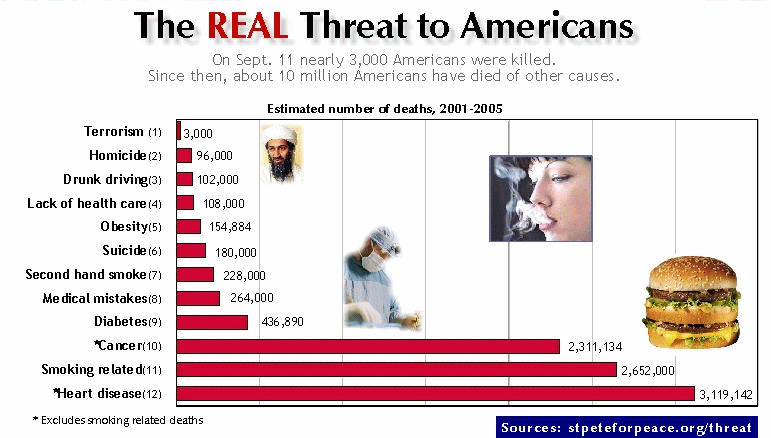
There are more people talking about Ebola than there are people who actually have it in North America. 30,000 people die from the flu annually, yet there's no special task force.


Let's declare a war on fast food
 
Ashley Madison
Vancouver Escorts